


The Bundesanstalt für Materialforschung und -prüfung (BAM) and the Marburg-based start-up LATODA, in Germany, have developed a method to increase the energy yield of wind turbines.
In the process, turbine rotor blades are checked for erosion using thermography and artificial intelligence, enabling early detection of damage.
The inspection procedure has now been successfully tested in a feasibility study led by BAM.
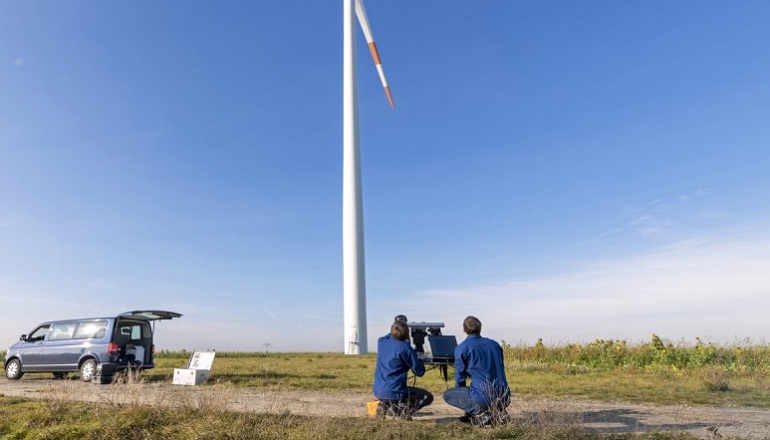
In this process, erosion damage to the rotor blades is made visible through thermographic images taken with an infrared camera.
The thermographic inspection of rotor blades, in which a camera system takes pictures from the ground, takes about 10 minutes, compared to conventional inspection procedures with industrial climbers, which usually take two-to-three days.
Downtime can be reduced.
The thermograms are then analysed with complex image processing and AI algorithms, registering and marking the smallest temperature differences on the surface of the rotor blades.
Michael Stamm, head of the project at BAM, said: “The inspection of rotor blades using thermography is a very fast and innovative method.
“However, you need a lot of experience and technical understanding when it comes to evaluating the images generated.
“Here, an automated image evaluation with artificial intelligence represents a great potential to decide even faster and more reliably after the measurement which concrete measures are to be initiated by the operators of the turbines.”
The results of the study will be presented at an open workshop at BAM on 2 March and discussed with representatives from science, industry and certification bodies.