


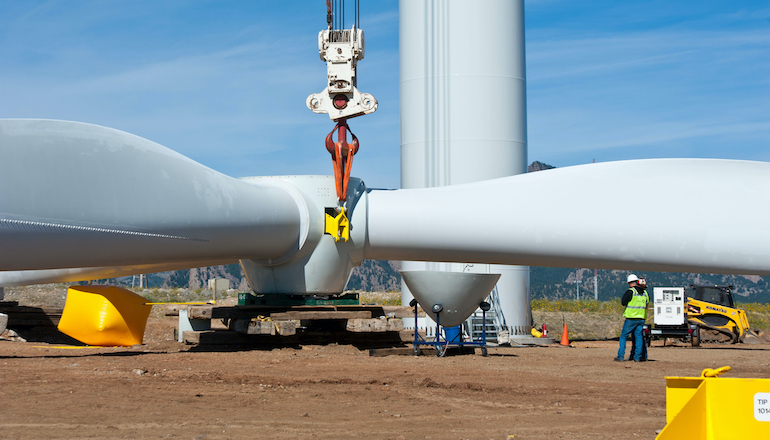
Infrastructure fund Greencoat UK Wind has awarded an £111,000 grant to engineering researchers at Imperial College London to develop an end-of-life decision making tool for turbine blades.
Many of the first wind farms constructed in the UK and Europe are now reaching the end of their designed life, raising the question of how best to dispose of the old machines once they have been dismantled, Greencoat said.
Most turbine parts, such as the steel and aluminium, can be easily recycled but some materials, particularly the fibreglass in blades, are more challenging, it added.
There are many technologies and processes that are being trialled and developed to address the challenge of recycling fibreglass.
Other disposal routes include repurposing and reusing these materials.
However, what isn’t being considered in end-of-life recycling processes, is the internal damage and material degradation turbine blades accumulate during their 25 to 30-year service life, the fund said.
The Greencoat-backed three-year research project, led by Dr Soraia Pimenta, will see the development of an end-of-life decision-making tool to predict how much damage a blade has accumulated in its lifetime.
The tool aims to support the wind industry in making more informed decisions about the optimal end-of-life route for turbine materials.
Dr Pimenta said: “A key challenge to the successful recycling and repurposing of end-of-life wind turbine blades is determining how much damage has accumulated in the materials throughout their service life and how this impacts potential 2nd-life applications.
“Our research will address this question by developing advanced methods for structural analysis, material modelling and life-cycle assessment, and integrating them into a uniquely holistic tool for end-of-life management of wind turbine blade materials.”