


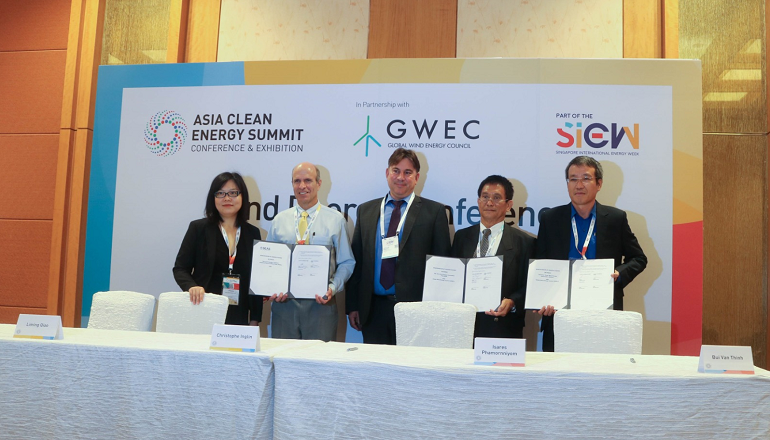
The Global Wind Energy Council (GWEC) has signed agreements with three renewable energy associations in south-east Asia to help promote the growth of wind power in the region.
The council signed memorandums of understanding with the Sustainable Energy Association of Singapore (SEAS), Binh Thuan Wind Energy Association (BWEA) in Vietnam, and the Thai Wind Energy Association (ThaiWEA) during the Wind Energy Conference during Singapore International Energy Week.
According to GWEC market intelligence, Vietnam and Thailand are well positioned to lead the energy transition in south-east Asia, with 1GW and 800MW of onshore wind expected to be installed over the next five years, respectively.
According to GWEC, while these markets have “strong fundamentals for renewable energy”, they still face challenges such as permitting, bankability of power purchase agreements and local capacity for financing.
The MoUs, said the council, “recognise the mutual interests of each organisation in upscaling wind energy and promoting its role in sustainable development.”
In addition, GWEC said the agreements “facilitate cooperation in the field of wind energy development, with a view to establishing positive policy environments and an acceleration pathway for wind power in the region, and particularly Vietnam and Thailand and support the development of technical activities, joint publications and other initiatives.”
GWEC Asia director Liming Qiao said: “South-east Asia will become a key growth region for renewable energy. Steady GDP growth, urbanisation and rising populations have fuelled the region’s electricity demand, which has increased by an average 6.1%.
“However, fossil fuels, and particularly coal-fired generation, continue to dominate the energy generation mix, with adverse socioeconomic and health impacts.
“It is imperative that stakeholders across South East Asia – from governments to investors to communities – work together to advance the deployment of clean energy. We are confident that through the new cooperation with our regional partners, we can overcome challenges such as system integration and market design, in order to promote the role of wind energy in south-east Asia’s sustainable development.”