


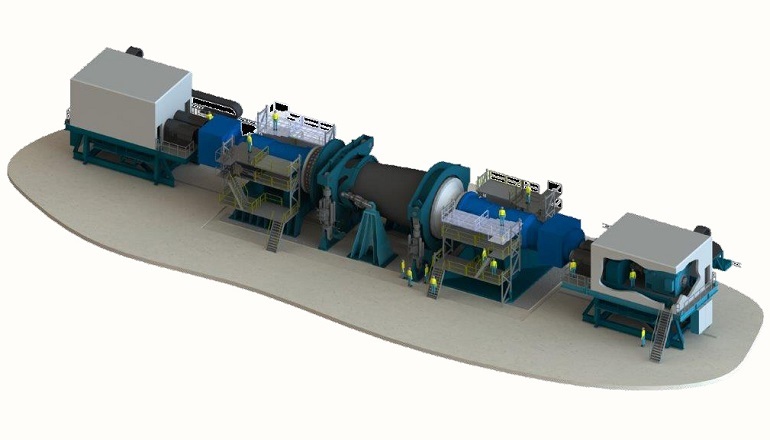
In its largest order to date, Danish wind turbine test specialist R&D Test Systems will develop a 30MW powertrain and gearbox test bench for ZF Wind Power.
The testbench will be installed in ZF’s future “Test & Prototype Center” in Lommel, Belgium, designed to house the world’s most powerful validation test bench for wind turbines.
With its two 30MW motors, the test rig will be the world’s most powerful powertrain and gearbox test bench and, at 60-metres long, also the largest.
Capable of simulating the multiplicity of wind loads that a nacelle powertrain might experience in its lifetime, the test rig, to be delivered in 2024, will help improve product reliability and shorten time to market.
“The wind loads, and directions can vary greatly, and each change creates loading on the nacelle powertrain,” said Ralf Nieschler, Key Account Manager, R&D Test Systems.
“This new test rig must be much more powerful than the powertrain it tests, providing proof that the next generation of offshore turbines of, say, 20MW are capable of operating reliably in extreme offshore conditions over the defined lifetime.”
Nieschler added: “The force of gusts wind can be a bit like a herd of elephants, pushing the blade around.
“This twisting and bending of the powertrain in all possible directions in the test rig will simulate the effect of 20 years of wind conditions in just a few months.”
The test rig employs the company’s “back-to-back” concept, where two nacelle components – for example two powertrains or two gearboxes – are tested simultaneously, leading to significant time savings.
Performing high-torque twisting, the 30MW motors are positioned on each end of the nacelle components under test.
Additionally, a specially designed load unit is located between the nacelle components and provides the wind loads needed to simulate the varying real-world conditions.
Together the motors and the load unit can simulate not only the harshest loads of wind but also the effect of wind coming from different directions.
Despite weighing 5700 tons and with a drive torque of 45 million Nm – equivalent to the load of 30 family cars dangling from the end of a 100m turbine blade – and a bending momentum of up to 64 million Nm, the test rig can cope with test components of varying dimensions.
A team of 35 full-time engineers have already started work on the test rig together with international specialist suppliers.
The test rig will be transported as individual modules to Belgium.
Also, part of the project is a crane with a lifting capacity of 300 tons for mounting of test powertrains into the rig.