


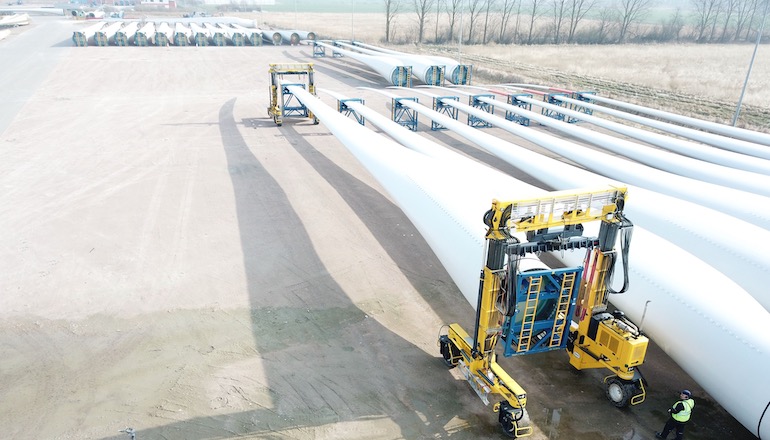
Nordex Group is planning to cease blade production at its Rostock factory in Germany at the end of June, impacting about 600 of the company’s employees.
The German turbine manufacturer said: “The increasingly challenging market environment and strong competition together with a shift in demand require Nordex Group’s global production and sourcing processes to be adapted.”
It added that since the introduction of auction systems in many energy markets, the industry has been globally characterised by increasing price competition.
Nordex said: “Those power producers who submit the lowest bids are awarded the contract and then pass on the price pressure to the turbine manufacturers.
“They, in turn, have to reduce their production costs to remain competitive.
“The cost of energy production from wind have halved in the last five years and this development has had a negative effect on the manufacturers’ profitability.”
The company added that against this backdrop, blade production at Rostock is, “despite the cost-saving measures already implemented, not competitive within the Nordex Group’s global production network and world-wide project business”.
In addition, the Rostock plant manufactures blades for turbines with a 149-metre maximum diameter, while the global trend has been developing towards more efficient turbines with ever longer rotor blades.
“Consequently, demand for the blades which can be manufactured at Rostock will continue to decline,” Nordex said.
The company added that staff have been informed that it is considering to cease production.
A reconciliation of interests and a severance scheme are to be negotiated with the works council in the short term in order to make the planned reduction in staff socially acceptable, it said.
Nordex employs about 8600 people worldwide, with approximately 3150 in Germany.
Nordex Group chief executive Jose Luis Blanco said: “The wind industry operates in a highly competitive, global market that is mainly cost-driven.
“Against this background, we must optimize our global production and sourcing processes in order to ensure profitable production and to secure the Nordex Group’s competitiveness.
“As a German and European-based company, we particularly regret that we do not see an alternative to this painful measure.
“We need an industrial policy that aims for a sustainable and comprehensive way to decarbonise and foster supply chain independency.”
Rostock is also home to a nacelle, hub and drive trains production site, as well as to engineering and service organisation staff.
These employees are not affected by the decision, Nordex said.