


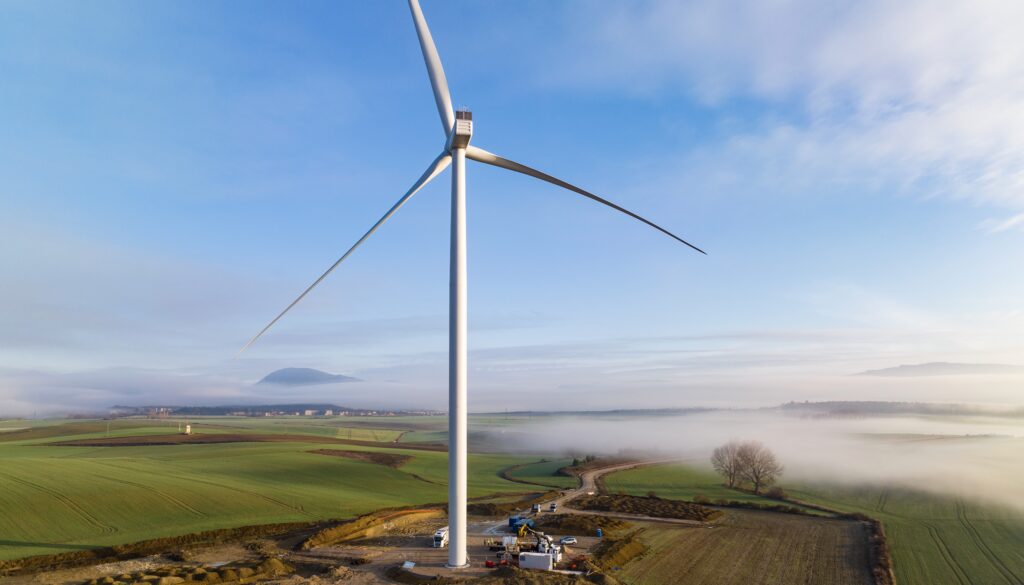
RWE has commissioned its onshore wind project Orkoien (pictured) near Pamplona, Spain which aims to reduce the environmental impact of the site.
While constructing a 5.7MW onshore wind turbine, RWE tested two technologies to reduce environmental impact during the plant’s construction phase on the one hand and greenhouse gas emissions during its subsequent operation on the other.
Both technologies have been implemented successfully, RWE said.
Chief executive of RWE Renewables Europe & Australia Katja Wünschel said: “More green electricity produced even more sustainably. That is what we are working towards.
“At Orkoien our team has shown what smart engineering solutions can achieve. We take these learnings and plan to apply them to other projects as well.
“This fits perfectly with our strong sustainable growth strategy, both here in our core market Spain and globally.”
During the construction phase, special plastic mats were used for the first time in Spain.
In temporary work areas such as access roads and storage sites they minimise the construction-related impact on the soil, RWE said.
Normally, these areas are excavated and gravelled, but now, only the surface needs to be smoothed using the excavator.
Then the access and storage areas are temporarily covered with the plastic overlays, it added.
Once the work is over, the vegetation can regenerate completely. Another advantage is that the mats, which are partly made of recycled material, can be reused in other projects, according to the developer.
President and chief executive of RWE Renewables Iberia Robert Navarro added: “The plastic mats surpassed our expectations.
“During the construction of Orkoien we faced harsh weather conditions with heavy rains and flooded soil.
“Nevertheless, we had secure access roads for the installation of the wind turbine. That is why the mats are now part of our construction toolbox for upcoming projects.”
The second technology, which has being used for the first time in the Orkoien pilot project, avoids the use of a greenhouse gas, RWE said.
In the medium-voltage switchgear at the base of the turbine tower, the use of an insulating agent in the circuit breaker is necessary to interrupt the electrical currents by cooling and extinguishing the arc that occurs when a circuit is opened.
Until now, the gas SF6 (sulphur hexafluoride), which is colourless, odourless, neither toxic nor flammable, and harmless to humans and animals, has been used for this purpose.
As it is a greenhouse gas that impacts the climate, it may only be used under strict conditions, RWE said.
With the use of “SF6-free switchgear”, RWE tested an alternative.
This new technology relies 85% on dry air and 15% on C5 fluoroketones as an insulating agent, it added.
In addition to being environmentally friendly, the technology has the same technical reliability as SF6. RWE is thus also preparing for the SF6 ban announced by the EU for new plants from 2031.