


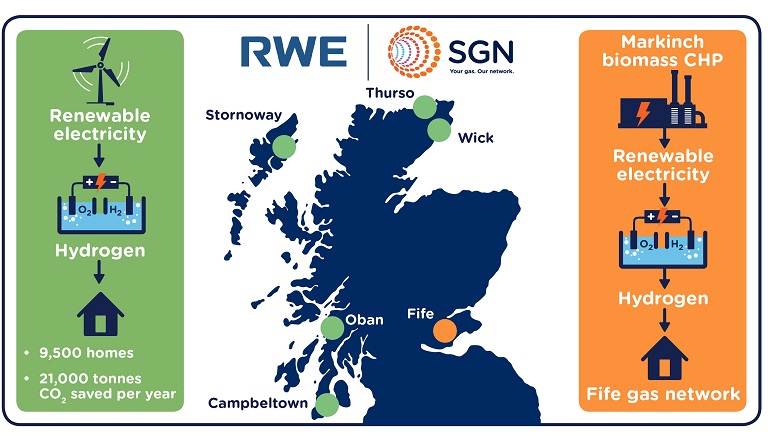
RWE and SGN have signed a memorandum of understanding (MoU) to investigate the development of wind-supplied electrolysis in Scotland to supply heating demand.
Electricity from RWE’s Scottish onshore wind portfolio, which has a combined capacity of 213MW, will be used to produce hydrogen to supply homes and businesses via Scotland’s gas network.
The partnership will investigate the decarbonisation of homes and businesses connected to the networks of Campbeltown, Stornoway, Oban, Thurso and Wick, which are not connected to the mains gas network.
These networks are currently supplied by liquified natural gas (LNG) and liquified petroleum gas (LPG), which when swapped with hydrogen could save 21,000 tonnes of carbon each year and decarbonise around 9500 properties.
The partnership will define how much hydrogen is needed, the requirements to convert these networks to hydrogen, and the supply of green electrolytic hydrogen from RWE’s onshore wind farms nearby.
In doing so, the project could also unlock onshore wind farm developments in grid-constrained areas, by providing a use for the green electricity generated.
A feasibility study will also be conducted over the coming months into a 100MW electrolyser at RWE’s Markinch combined heat and power biomass plant.
This could produce green hydrogen from local and grid connected renewable energy, to connect into SGN’s gas network in Fife.
It would build on the work SGN is already undertaking in Levenmouth on its H100 Fife project.
Steve Boughton, RWE’s director of hydrogen development, said: “This MoU is a perfect partnership to develop options for the decarbonisation of domestic and business gas networks, and to help Government achieve its ambitions for 10GW of hydrogen production.
“Hydrogen will play an essential role in the pathway to net zero, particularly in industry and homes which are hard to decarbonise, and RWE is perfectly positioned to support the development of the UK hydrogen economy.”