


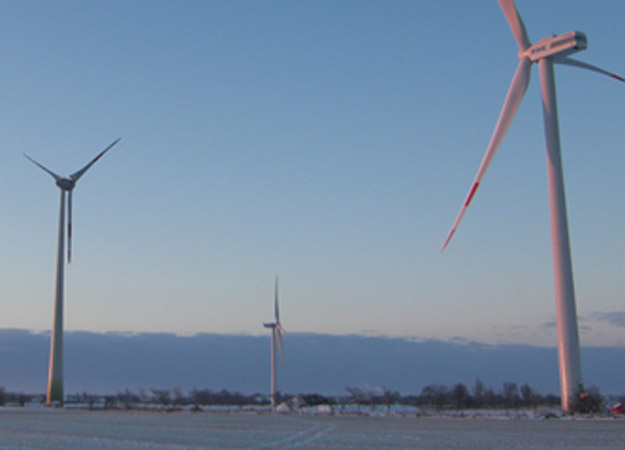
RWE has joined a study in the Netherlands that will explore an approach to mitigate bird collisions with wind turbine rotor blades.
In the Zwarte Wiek study seven of RWE’s wind turbines in Eemshaven, in the Netherlands, will have one of their three blades painted black, to show whether this can help birds to fly safely between the turbines.
The study is based on the idea that a turbine with one black blade is more visible to birds, allowing them to better avoid the blades.
Monitoring is to be carried out for three years.
The Dutch research project is a follow-up to an earlier Norwegian study and focuses on local bird species.
In addition, aviation safety and the effect of the black blades on the landscape and on the painted blades themselves will be examined.
RWE and the province of Groningen started the research in 2021, in collaboration with the Dutch government (ministries of Economic Affairs and Rws, provinces of Flevoland, Gelderland, Overijssel, Limburg, Zuid-Holland and Noord-Brabant), the nature sector (Vogelbescherming) and private companies in the wind sector (Vattenfall, Eneco Energy, Pure Energy, Statkraft Energy and Groningen.nl Energy).
The research will last until 2024.
The ecological part of the research started in September last year with a baseline measurement in which researchers from two research agencies looked at 14 wind turbines every week how many birds flew into them.
RWE’s wind farm in Eemshaven lends itself to the study due to the number of birds in the area, as Eemshaven is a meeting point for migratory birds in spring and autumn and there is a wide range of bird species in the area.
For example, species include seabirds, such as gulls and terns, but also songbirds such as blackbirds and starlings and birds of prey such as buzzards and kestrels.
An important question in this part of the research is to gauge the effect of the black-painted blades will have in mitigating collisions with turbines among these different types of birds.
When the paint is on, it must be shown what the effect of this is on the material of the blade.
With thermometers in the blades and additional inspections, the effect on the material will be monitored.
In addition, the study will monitor any impact or consequences for preventive maintenance and production of the turbines.
Pilots who regularly fly over the area will also be consulted in the context of aviation safety.