


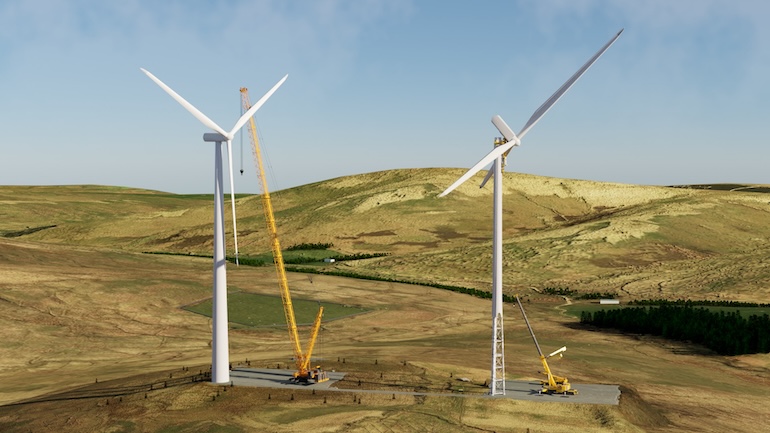
An installation technology originally developed for offshore wind could significantly cut costs for large-scale onshore projects, according to a new study.
Consultancy Natural Power said modelling shows the SENSE turbine installation system could reduce levelised cost of energy by 8.1% at Muirhall Energy’s proposed 350MW Teviot wind farm in Scotland.
The analysis, using data from SENSEWind and Muirhall Energy, found the system could deliver savings of about 8% on the development compared with a conventional tower and crane installation approach.
Natural Power added that the economic benefits could range from a 4.6% to 14.2% reduction in levelised cost of energy depending on site complexity.
The SENSE system uses a self-installing mechanism that transports the turbine’s rotor nacelle assembly to the top of a specially designed tower using a carriage running on an integrated rail system.
The concept removes the need for large cranes for turbine installation and major maintenance operations by relying on smaller and more widely available cranes.
“We estimate this will save the Teviot project over £40m in reduced CapEx and OpEx over its operational life, as well as increasing turbine availability and energy production through faster and safer maintenance operations and, if necessary, rapid major component replacements,” said SENSEWind chief executive and founder Patrick Geraets.
The study said the cost benefits are particularly pronounced at more complex sites where crane logistics and installation constraints are greater.
“The results of this latest study clearly demonstrate our investment is paying off, and we are now looking at how to implement the SENSE system on our projects together with wind turbine suppliers,” said Muirhall Energy chief executive and founder Chris Walker.
The technology has been demonstrated on a Vestas V27 wind turbine and is being developed for use on modern large-scale turbines.
The proposed Teviot wind farm could have a capacity of up to 350MW and is expected to begin operating around 2033 using turbines in the 6MW to 8MW range with tip heights of up to 240 metres.