


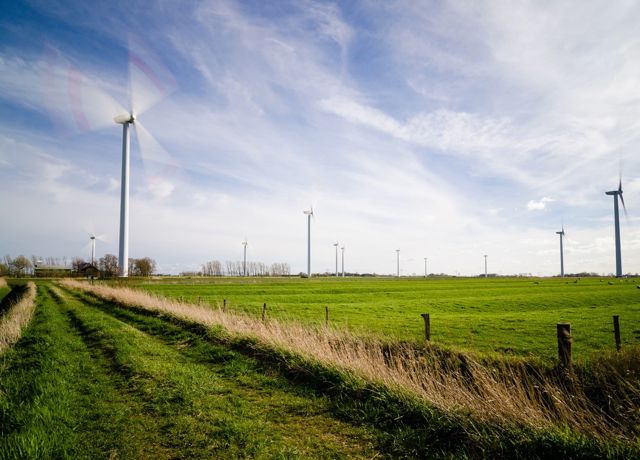
Researchers at Stanford University, in California, have shown that angling turbines slightly away from the wind can boost energy produced overall.
Pointing turbines slightly away from oncoming wind – called ‘wake-steering’ – can reduce that interference and improve both the quantity and quality of power from wind farms, and probably lower operating costs, according to the new research.
The study tested its modelling on a wind farm in Alberta, Canada, in collaboration with operator TransAlta Renewables.
The overall power output of the farm increased by up to 47% in low wind speeds, depending on the angle of the turbines.
In average wind speeds the output saw a 7-13% boost.
The results of the study were published on 1 July in Proceedings of the National Academy of Sciences.
Stanford professor of civil, environmental and mechanical engineering John Dabiri said: “To meet global targets for renewable energy generation, we need to find ways to generate a lot more energy from existing wind farms.
“The traditional focus has been on the performance of individual turbines in a wind farm, but we need to instead start thinking about the farm as a whole, and not just as the sum of its parts.”
Turbine wakes can reduce the efficiency of downwind generators by more than 40%.
Previously, researchers have used computer simulations to show that misaligning turbines from prevailing winds could raise production of downstream turbines.
However, showing this on a real wind farm has been hindered by challenges in finding a facility operator willing to halt normal operations for an experiment and in calculating best angles for the turbine.
Initially the Stanford team developed a faster way to calculate the optimal misalignment angles for turbines, before testing their calculations on the wind farm in Alberta.
“Through wake steering, the front turbine produced less power as we expected,” said mechanical engineering PhD student Michael Howland, lead author on the study.
“But we found that because of decreased wake effects, the downstream turbines generated significantly more power,” he added.
In slow winds, wake-steering reduced the amount of time that speeds dropped below the minimum that leads to power cut-out, the researchers found.
Notably, the biggest gains were at night, when wind energy is typically most valuable as a complement to solar power.
In the study, wake steering reduced the very short-term variability of power production by up to 72%.
The researchers also suggested that reducing variability can help wind farm owners lower their operating costs as turbulence in wakes can strain turbine blades and raise repair costs.
Dabiri said: “The first question that a lot of operators ask us is how this will affect the long-term structural health of their turbines.
“We’re working on pinpointing the exact effects, but so far we have seen that you can actually decrease mechanical fatigue through wake steering.”
While designing wind farms is typically a data and computationally intensive task Stanford University established simplified mathematical representations that reduced the computational load by at least two orders of magnitude.
This faster computation could help wind farm operators use wake steering widely.
“If we can get to the point where we can deploy this strategy on a large-scale for long periods of time, we can potentially optimize aerodynamics, power production and even land-use for wind farms everywhere,” said Dabiri.