


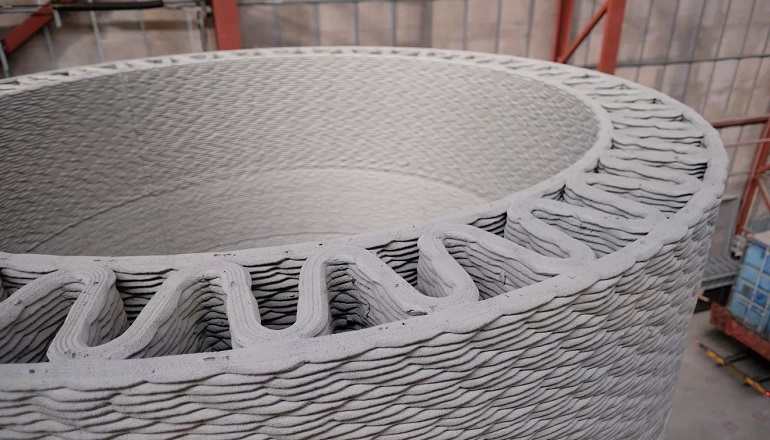
GE Renewable Energy and its partners COBOD and LafargeHolcim will co-develop wind turbine towers with 3D-printed concrete bases to achieve record-breaking heights of up to 200 metres.
The three partners will undertake a multi-year collaboration to develop the towers and process for making them.
The companies will produce a wind turbine prototype with a printed pedestal, a production ready printer and materials to scale up production.
Taller towers can help increase wind farm production by enabling turbines to capture stronger winds that are higher up, lowering the levelised cost of energy (LCoE).
Printing a variable height base directly on-site with 3D-printed concrete technology will enable the construction of towers up to 150-200 metres tall.
Typically, a 5MW turbine at 80 metres generates 15.1 gigawatt-hours (GWh) of energy annually.
In comparison, the same turbine at 160 metres would generate 20.2GWh, or more than 33% extra power, GE said.
The first prototype, a 10-metre high tower pedestal, was successfully printed in October 2019 in Copenhagen, Denmark.
GE Renewable Energy will provide expertise related to the design, manufacture and commercialisation of wind turbines.
COBOD will focus on the robotics automation and 3D printing.
LafargeHolcim will design the concrete material, its processing and application.
LafargeHolcim R&D head Edelio Bermejo said: “Concrete 3D printing is a very promising technology for us, as its incredible design flexibility expands the realm of construction possibilities.
“Being both a user and promoter of clean energy, we are delighted to be putting our material and design expertise to work in this ground-breaking project, enabling cost efficient construction of tall wind turbine towers and accelerating access to renewable energy.”
COBOD founder Henrik Lund-Nielsen added: “We are extremely proud to be working with world-class companies like GE Renewable Energy and LafargeHolcim.
“With our ground-breaking 3D printing technology combined with the competence and resources of our partners, we are convinced that this disruptive move within the wind turbines industry will help drive lower costs and faster execution times, to benefit customers and lower the CO2 footprint from the production of energy”.
GE Renewable Energy advanced manufacturing technology leader Matteo Bellucci said: “3D printing is in GE’s DNA and we believe that large format additive manufacturing will bring disruptive potential to the wind industry.
“Concrete printing has advanced significantly over the last five years and we believe is getting closer to have real application in the industrial world.
“We are committed to taking full advantage of this technology both from the design flexibility it allows as well as for the logistic simplification it enables on such massive components.”
Wind turbine towers have typically been limited to a height of under 100 metres, as the width of the base cannot exceed the 4.5 metre diameter that can be transported by road, without additional costs.