


Wind industry leaders and European policy makers have called for more cross-sector collaboration to drive the changes required to meet European and global climate goals.
Speaking at the opening of WindEurope’s annual conference in Copenhagen, they have highlighted the need for the wind energy sector to join forces with other economic sectors to boost electrification in line with the EU’s 2030 and 2050 targets.
Andreas Nauen, Siemens Gamesa CEO and Chairman of WindEurope, said it is “now critical” for the wind sector to work in tandem with the transport, shipping, building and industrial sectors, using commercially available technology to keep costs down for consumers.
“Direct and indirect electrification is the most cost-effective way to achieve climate targets,” said Nauen. “However we need to collaborate more closely to accelerate the progress we have already made.”
The transport sector is making good progress, with EVs now accounting for around 17% of all new car sales, said Nauen, but more work is required in the heating, shipping and building sectors.
According to WindEurope, electricity accounts for around 25% of all the energy consumed in Europe. The EU wants this to increase to 75% by 2050, however, with 57% of energy consumption powered directly by electricity and another 18% coming from renewable hydrogen and its derivatives.
Achieving these targets will require huge growth in installed renewable energy capacity as well as a transformation of Europe’s economies.
Jan Hylleberg, CEO of WindDenmark said: “Today no city or country is fully electrified, but this will happen sooner than we think.
“Electrification is our main task, alongside keeping industry competitive. To do this, we will need to engage in close dialogue with other sectors.”
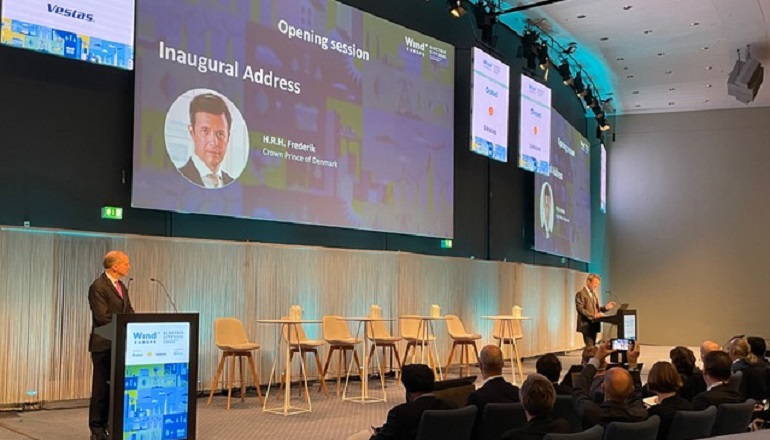
WindEurope’s three-day Electric City 2021 event is aiming to highlight the challenges and opportunities the wind industry faces in the fight against climate change. It was officially opened by Crown Prince Frederik of Denmark (pictured), who said that the green transition would go “hand in hand” with socio-economic prosperity.
“The challenge is immense but so is the potential,” said the Crown Prince.
To electrify its energy system, the EU needs to boost its wind capacity to 1000GW of onshore and 300GW of offshore wind by 2050, up from a combined 180GW today.