


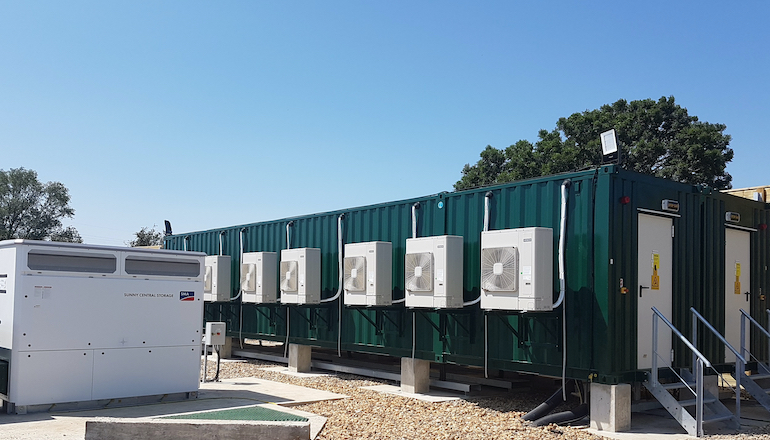
Gresham House Energy Storage Fund has partnered with Origami and Habitat Energy to prepare 50MW of battery assets to participate in the Dynamic Containment (DC) and wholesale markets.
The move follows the discontinuation of National Grid’s Enhanced Frequency Response (EFR) service.
With the discontinuation of EFR, a service in place since late 2016, numerous battery assets throughout the UK require upgrades to participate in the new markets that are replacing it, including DC, Dynamic Regulation (DR) and, in the near future, Dynamic Moderation (DM).
Gresham House Energy Storage Fund is using Origami’s platform at its 40MW Glassenbury A and 10MW Cleator projects, to “manage the extraction and orchestration of operational data” from the assets, enabling their participation in DC for the first time.
The move also “future proofs” the assets’ ability to “switch seamlessly” between other current and emerging ancillary markets.
To make the assets compatible with DC, Origami is providing a combination of specialist router hardware installation and software interfacing, which will allow precisely controlled readings on battery output, capacity, and condition to be generated up to 20 times a second.
Having fully integrated with the Origami platform, battery optimiser Habitat Energy will use this data stream to control and optimise the batteries on behalf of Gresham House Energy Storage Fund.
Dan Hodges, head of commercial at Origami, said: “In a market segment as dynamic and valuable as energy storage, asset owners face an ongoing challenge to avoid assets becoming temporarily stranded.
“With the right digital infrastructure in place, these risks can be managed very effectively through swift, data-enabled actions.
“We’re pleased to have been trusted to solve this problem for Gresham House.”