


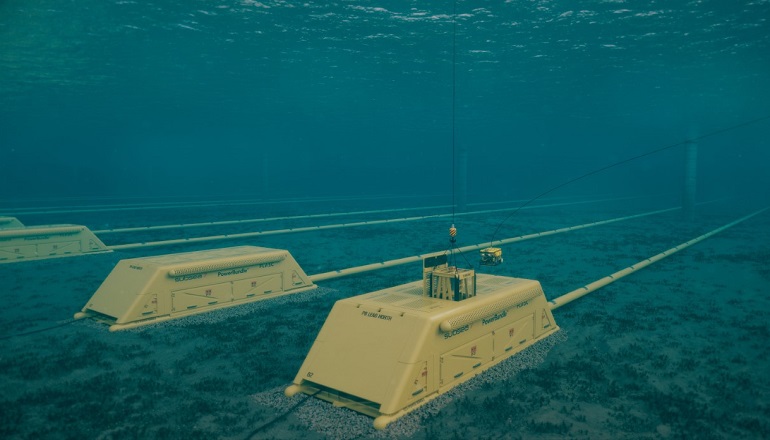
Subsea 7 and technology partner FLASC have been awarded a grant of nearly half a million pounds, from the UK government, to further develop an offshore energy storage system.
Funding of £471,760 has been awarded to the partners by BEIS as part of the Longer Duration Energy Storage (LODES) Competition.
The competition recognises the transition to increasing wind-generated renewable energy, which presents growing opportunities for storage systems that support a secure, flexible and reliable electrical power supply.
The PowerBundle concept will combine FLASC’s proprietary hydro-pneumatic energy storage (HPES) technology and Subsea 7’s proven subsea pipeline bundle technology, resulting in a scalable and robust offshore energy storage system.
Liam Macintrye, Subsea 7 strategic director for the energy transition, said: “We are very pleased to have our innovative solution recognised by BEIS, as it builds on our proactive participation in the energy transition.
“The development of energy storage solutions plays a crucial role in the future of intermittent renewable power sources, and the interconnectivity of our energy systems.
“We believe such systems will not only unlock additional grid connected offshore wind, but it could also play a valuable role in decarbonising oil and gas assets.”
FLASC chief executive Daniel Buhagiar, said: “This funding support from UK BEIS provides a major boost to our technology development initiatives, and we are extremely proud to have been selected in this pioneering and highly-competitive funding programme; one of the first specifically targeting longer duration energy storage.
“Beyond the financial support, this also confirms our view that offshore energy storage technologies have a key place in the energy transition, working alongside onshore solutions towards a cleaner and more robust energy system.”
The competition will be delivered through two phases.
In phase one, projects will be expected to mobilise their proposed technologies to prepare for potential deployment on the UK energy system.
Successful proposals will receive further funding for phase two, to build and test a grid connected full-system demonstrator of the proposed technology and qualify it through testing.
A formal stage gate review will take place between phase one and phase two of the competition.
Work has already commenced for phase one.