


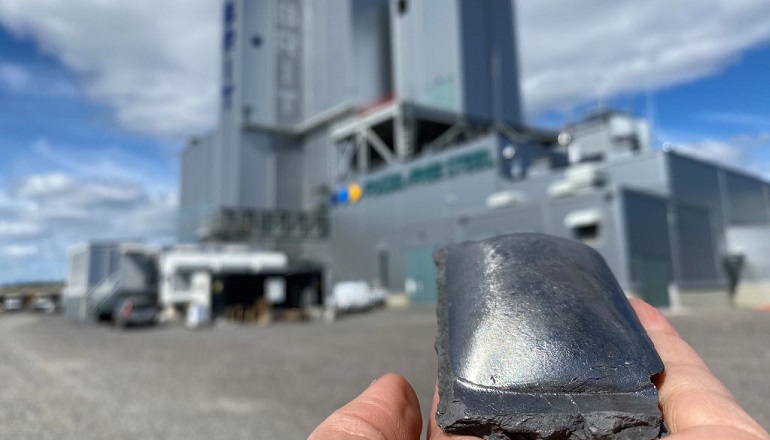
A project in Sweden that will use green hydrogen to produce steel is one of seven chosen for a grant under the EU’s €1bn Innovation Fund.
The grants will support projects aiming to bring breakthrough technologies to the market in energy-intensive industries, by deploying hydrogen, carbon capture and renewable energy.
The projects, which will have a share of €1.1bn from the EU’s first Innovation Fund, are located in Belgium, Italy, Finland, France, the Netherlands, Norway, Spain and Sweden.
Independent experts evaluated the projects for their ability to reduce greenhouse gas emissions compared to conventional technologies and to innovate beyond the state-of-the-art while being sufficiently mature to enable their quick deployment.
Other selection criteria included the projects’ potential for scalability and cost effectiveness.
The project in Sweden aims to entirely eliminate greenhouse gas emissions from steel production by using renewable hydrogen in Gallivare and Oxelosund.
The “HYBRIT demonstration project” will replace coal-based blast furnaces with direct hydrogen-based reduction technology, demonstrating a complete industrial value chain for hydrogen-based iron and steelmaking. The project’s output will represent 25% of Sweden’s annual crude steel production.
A new facility will be established for first-of-a-kind hydrogen-based direct reduction, with 500MW fossil-free electrolysis in Gallivare.
Another project, in Finland, will demonstrate two ways of producing clean hydrogen at a refinery in Porvoo, through renewable energy and by capturing carbon dioxide and storing it in the North Sea.
Another of the seven projects, located in Italy, will develop an industrial-scale pilot line for the manufacture of innovative and high performance photovoltaic cells in Catania.
Successful projects are starting to prepare the individual grant agreements with the European Climate, Infrastructure and Environment Executive Agency (CINEA), the implementing body of the Fund.
These are expected to be finalised in the first quarter of 2022, allowing the European Commission to adopt the corresponding grant award decision and start distributing the grants.
On 26 October, the Commission launched the second call for large-scale projects with a deadline of 3 March 2022 and all the projects that were not successful in the first call are encouraged to re-apply.