


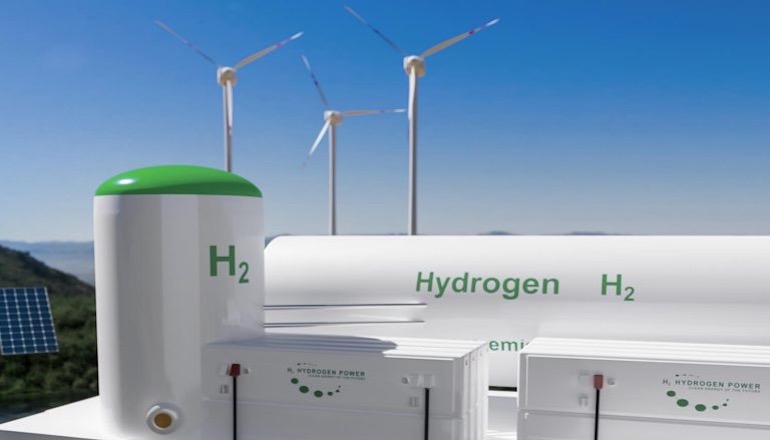
New rules that define what qualifies as green hydrogen in the EU will help to ensure the fuel is low carbon but will raise cost of procurement for end users, according to BloombergNEF.
To enable the scale-up of the industry, the EU recently released its definition of hydrogen that will qualify as green.
Europe has taken a lifecycle approach to measuring emissions from hydrogen, setting an emissions threshold of 3.38kg CO2-equivalent per kg-H2, covering energy inputs to make hydrogen through to consumption.
The proposed rules in the EU favour hydrogen projects in locations with high shares of renewables.
According to BloombergNEF’s analysis, since Norway’s grid is 90% renewable, a grid-connected electrolyser could qualify as green and achieve a levelised cost of hydrogen (LCOH2) of $2.58/kg in 2025 while ensuring stable output.
However, in most EU countries, the bloc’s definitions will give preference to co-located wind and solar as the power source.
Hydrogen produced from wind and solar in Portugal could cost 4% less than a grid-connected project in Norway but would only have a 50% utilisation rate, the analysis found.
Strict temporal correlation will “drive up” the cost of stable hydrogen production required by industrial end users, since the EU requires hourly matching of H2 production and renewables generation, limiting an electrolyser’s utilisation rate without additional energy storage.
According to BloombergNEF, an off-grid project in Germany could produce stable hydrogen using solar, wind and batteries for an LCOH2 of $4.91/kg in 2025, nearly double that of a grid-connected project in Norway.
The carbon contracts-for-difference (CCfD) scheme will bridge the gap, stated BloombergNEF.
Due to begin in autumn 2022, the CCfD will ensure green hydrogen is competitive for industrial applications.
The analyst calculated that if 20% of the EU Innovation Fund budget in 2025 went to green steel projects using hydrogen, the scheme would support 55,085 tonnes of annual renewable hydrogen production.