


The PtX Development Fund for the promotion of hydrogen projects in developing and emerging economies has approved its first grant for a project in Egypt.
Egypt Green Hydrogen (EGH) will receive €30m for an electrolyser project in the Suez Canal Economic Zone (SCZone), the largest industrial cluster in Egypt.
EGH’s project, due online in 2028, is backed by a consortium including project developer Scatec, Orascom Construction and The Sovereign Fund of Egypt.
The EGH project will be supplied with electricity from wind and solar power from newly built plants with a total capacity of 270MW to produce green hydrogen, which is then transformed into green ammonia for use in fertiliser production and as a hydrogen vector.
EGH has access to an existing ammonia production facility at a well-connected site in the SCZone.
The consortium plans to invest a total of approximately €500m in the production of green hydrogen in the SCZone.
EGH has concluded a 20-year purchase agreement for green ammonia with fertiliser manufacturer Fertiglobe.
KGAL Investment Management, the fund manager mandated by KfW, had reviewed a total of 98 applications from seven countries before selecting EGH.
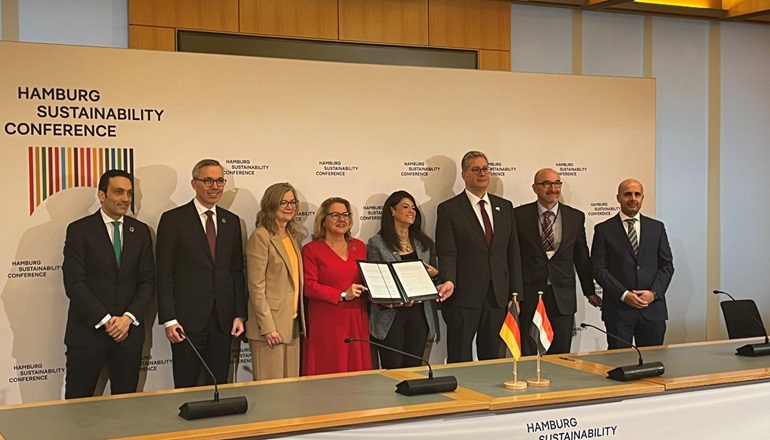
The contract was officially signed (pictured) on 8 October at the Hamburg Sustainability Conference in the presence of Svenja Schulze, German Federal Minister for Economic Cooperation and Development (BMZ), Rania Al-Mashat, Egypt’s Minister of Planning, Economic Development and International Cooperation and Karim Badawi, Egypt’s Minister of Petroleum and Mineral Resources.
The second round of applications is expected to start in winter 2024/25.
The PtX Development Fund,initiated by the BMZ and endowed with €270m, is part of KfW’s PtX Platform for promoting hydrogen projects in the global South.
“The production of green hydrogen and its derivatives offers enormous potential for the development and transformation of local economies, especially in emerging and developing countries.
“Green hydrogen also serves a variety of strategic and economic interests for us in Germany and Europe, helping us achieve our climate targets and the global energy transition.
“At the same time, we are strengthening our domestic industries by opening up new markets for our export economy,” said Christiane Laibach, member of the KfW Executive Board.