


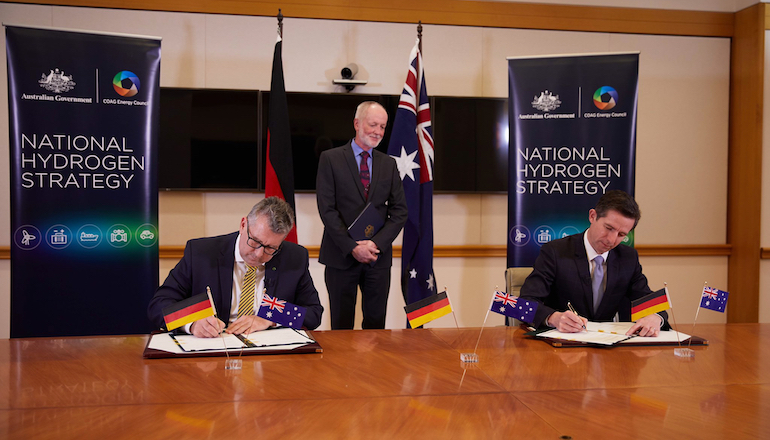
Germany and Australia have signed an agreement to carry out a feasibility study into the potential for closer collaboration and the future development of a hydrogen supply chain between the two countries.
The agreement is between the departments of Foreign Affairs and Trade and Industry, Science, Energy and Resources of Australia and the Federal Ministry of Education and Research of the Federal Republic of Germany.
The study will focus on the comparison of the current technology and research readiness levels along the whole supply chain.
It will also look at the exchange of technologies, knowledge and experiences between the partners on both sides, as well as assess Australia’s potential to produce hydrogen and hydrogen-based energy carriers from renewables for export to Germany and associated markets.
Other areas that will be looked at include identification of economic, technological and regulatory requirements for the transport of and trade in hydrogen from renewables, and determination of demand and end use for the gas.
Economic, scientific, technological, regulatory and logistical barriers will examined and business models for green hydrogen identified.
Australian minister for Trade, Tourism and Investment Simon Birmingham said partnerships with countries such as Germany would be key to the development of a strong and world-leading hydrogen industry in Australia.
He said: “These kinds of partnerships will be critical to further developing our emerging hydrogen industry and Australia’s future as a powerhouse in clean energy exports.
“Exploring opportunities for future collaboration on commercial scale operations and investments in hydrogen production is vital if Australia is to realise the significant economic benefits and job creation opportunities hydrogen brings.
“This study gets the ball rolling on the development of future hydrogen supply chain with Germany which could lead to billions of dollars in export earnings for Australia and help them meet their future clean energy ambitions.
“With Australia well positioned to be a major supplier of low emissions hydrogen, and global demand for hydrogen continuing to grow, we need to continue to develop links with future importers around the world.”
Minister for Resources Keith Pitt said the study will look to underpin the future of hydrogen supply and help to inform two-way trade and investment between Australia and Germany.
He said: “This kind of cooperation is another step in helping to secure Australia’s clean-energy trading future which is backed by our abundant natural resources and strong history of being a reliable supplier.
“This agreement will open up another new market for our resources and potentially create thousands of new job opportunities for Australians well into the future.
“Clean hydrogen is a transformational fuel that can be used to power vehicles, generate heat and electricity, and as a chemical feedstock in major industrial applications.
“Australia has what it takes to be a world leader in hydrogen production and exports that will help our trading partners lower their emissions.”
Minister for Energy and Emissions Reduction Angus Taylor said collaborating with key partners such as Germany will help to drive down the cost of new hydrogen technologies.
He said: “Australia has the natural competitive advantage to be a world leader in exporting hydrogen. The expertise and infrastructure from our gas industry will assist us to use hydrogen as an energy source at home,” Minister Taylor said.
“Australia’s future hydrogen industry has the potential to generate 7,600 new jobs by 2050, many in regional Australia, with exports estimated to be worth around $11 billion a year in additional GDP.
“This is why the Australian Government has committed more than A$500m to back this industry’s development.”