


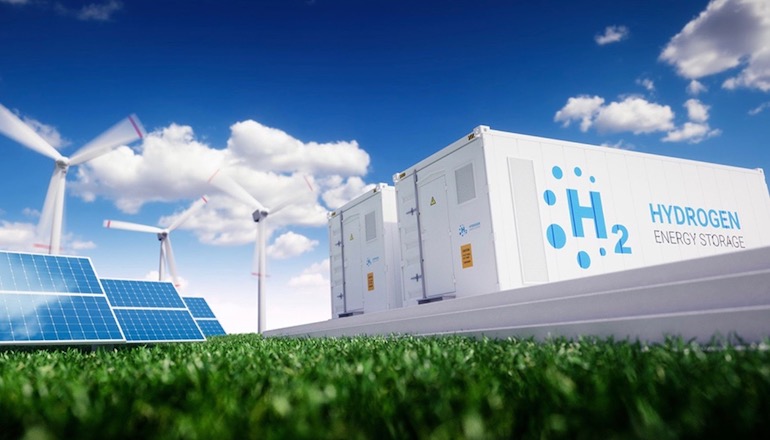
The falling cost of making hydrogen from wind and solar power could cut greenhouse gas emissions by 34% in fossil fuel dependent sectors of the economy, such as steel, heavy-duty vehicles, shipping and cement, according to new research by BloombergNEF (BNEF).
The ‘Hydrogen Economy Outlook’ found that the cuts are possible at a manageable cost, but this will only happen if policies are put in place to help scale up technology, and drive down costs.
Green hydrogen could be produced for $0.8 to $1.6 kilogram in most parts of the world before 2050, the report said.
BNEF said this price is equivalent to gas priced at $6-12/MMBtu, making it competitive with current natural gas prices in Brazil, China, India, Germany and Scandinavia on an energy-equivalent basis.
When including the cost of storage and pipeline infrastructure, the delivered cost of renewable hydrogen in China, India and Western Europe could fall to around $2/kg in 2030 and $1/kg in 2050, it added.
BNEF head of industrial decarbonisation and lead author of the report Kobad Bhavnagri said: “Hydrogen has potential to become the fuel that powers a clean economy.
“In the years ahead, it will be possible to produce it at low cost using wind and solar power, to store it underground for months, and then to pipe it on-demand to power everything from ships to steel mills.”
BNEF said that the cost of the electrolyzer technology to make hydrogen has fallen by 40% in the last five years, and can continue to slide if deployment increases.
Clean hydrogen can also be made using fossil fuels if the carbon is captured and stored, but this is likely to be more expensive, the report said.
It added that storing and moving hydrogen is challenging.
Therefore, for hydrogen to become as ubiquitous as natural gas today, a huge, coordinated programme of infrastructure upgrades and construction would be needed.
For instance, three to four times more storage infrastructure would need to be built at a cost of $637bn by 2050 to provide the same level of energy security as natural gas, the report said.
“If the clean hydrogen industry can scale up, many of the hard-to-abate sectors could be decarbonized using hydrogen, at surprisingly low costs,” Bhavnagri said.
The study found that a carbon price of $50 a tonne of carbon dioxide would be enough to switch from coal to clean hydrogen in steel making by 2050, $60/tCO2 to use hydrogen for heat in cement production, $78/tCO2 for making chemicals like ammonia, and $145/tCO2 to power ships with clean fuel, if hydrogen costs reach $1/kg.
Heavy trucks could also be cheaper to run on hydrogen than diesel by 2031, although batteries remain a cheaper solution for cars, buses and light trucks, BNEF said.
Policy is therefore critical for hydrogen to gain use, it added.
Bhavnagri said: “The clean hydrogen industry is currently tiny and costs are high. There is big potential for costs to fall, but the use of hydrogen needs to be scaled up and a network of supply infrastructure created.
“This needs policy coordination across government, frameworks for private investment, and the roll-out of around $150bn of subsidies over the next decade.
“That may sound daunting but it is not, in fact, such a huge task – governments around the world currently spend more than twice that every year on fossil fuel consumption subsidies.”
BNEF concluded that at the moment the outlook for a hydrogen economy is still uncertain, as there is insufficient policy to support investment and to scale up the industry.
“Even if that occurs, hydrogen would not be a silver bullet,” the report said.
Carbon prices and emission policies will still be essential to drive hydrogen use, particularly in locations with very cheap coal and gas.
Despite the potential cost reductions, hydrogen must still be manufactured – so it is likely to remain a more expensive form of energy.
Industry will not automatically switch to using it – a commitment to net-zero emissions is required, the report said.