The Department of Energy and Climate Change will consult in spring 2016 on policy options to remove regulatory barriers to energy storage with the aim of reducing the need for reserve generation capacity and network reinforcement.
The consultation will build the evidence base and test options for delivering DECC’s decarbonisation objectives out to 2050 more cost effectively via a ‘smart energy system’.
The consultation will be followed by a government response in autumn 2016, which will outline the future direction of the work.
By 2050, DECC estimates a smart system utilizing energy storage and demand-side response could realise up to £12bn of savings in avoided or deferred network reinforcement and up to £5bn in reduced generation investment by shifting demand away from the peak.
In today’s ‘Towards a Smart Energy System’ paper, DECC said it will look in detail with Ofgem at policy and regulatory barriers to energy storage, such as the licensing and charging framework for storage, and what it can do to address them.
The paper cites National Grid’s Consumer Power scenario, which estimates 30GW of solar connected to distribution networks by 2035. This could suppress demand significantly during the middle of the day as well as steepen ramp rates, making it more challenging to balance the system, it said.
The paper recognises energy policy and regulation have been designed around a traditional power generation system and have not always provided an appropriate framework for innovative, flexible solution.
“Incentives for market players are not always well aligned to ensure that the most efficient, flexible solution is chosen means providers of flexibility do not realise their full value, undermining their investment business case,” DECC said.
It added: “Existing business models may also mean incumbents have incentives to stick with the status quo.”
The consultation will also assess whether more fundamental changes are required to deliver a future smart system, including in the operation of the market and existing institutional arrangements. It also aims to develop a better understanding of the potential costs and benefits associated with delivering a smart energy system.
DECC said its work will also inform discussions at a European level around the EU’s Market Design initiative, and the broader EU Energy Union agenda.
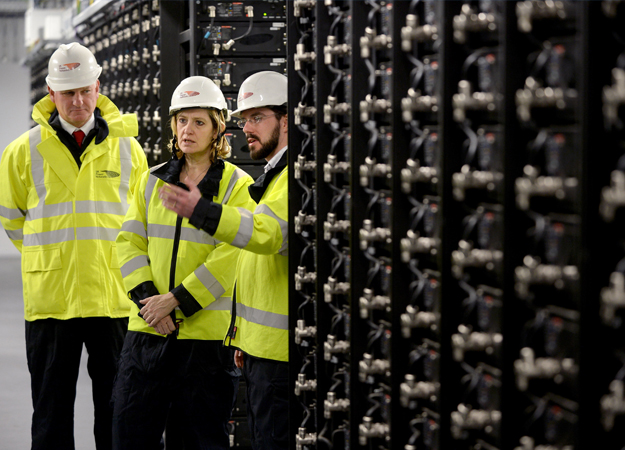
Image: Amber Rudd tours energy storage project (UK Power Networks)