


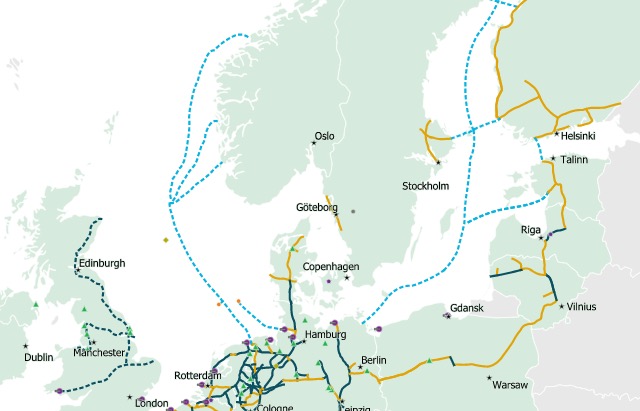
Energinet Systemansvar and Gasunie Deutschland have signed a Memorandum of Understanding (MoU) to accelerate preparations for cross-border green hydrogen infrastructure between Denmark and Germany.
The preparatory activities outlined in the MoU include a coordinated approach to grid development based on the results of the prefeasibility study and the latest market developments in both supply and demand.
Energinet and Gasunie will also analyze and outline the crucial decision gates on the way to final investment decisions.
Energinet Systemansvar chief executive Søren Dupont Kristensen said: “Hydrogen infrastructure enables us to fully exploit and export some of the huge renewable energy sources in Denmark and deliver on the Esbjerg agreement.
“At Energinet, we already feel a strong market interest in being able to supply the German hydrogen market with green hydrogen produced in Denmark – and the ambition is to realize this before 2030.
“A lot must fall into place before then, so I am very happy that we are now committing us to speed up the preparatory efforts and thereby support European energy supply security.
In May 2022, Germany, Denmark, Belgium and the Netherlands set a joint target of delivering at least 65GW of offshore wind power in 2030 and increasing capacity to at least 150GW in 2050.
In connection with the so-called Esbjerg agreement, the Danish and German governments entered into a declaration of intent to a strengthened cooperation on green hydrogen, including investigating a potential pipeline for hydrogen export from Denmark to Germany.
Gasunie Deutschland’s chief executive Jens Schumann said: “The strategic value of an intensified hydrogen collaboration between Denmark and Germany lies in the well-developed, high-performance infrastructure that already connects the two neighboring countries.
“It gives us direct access to Danish green hydrogen sources – without conversion to intermediate energy carriers such as ammonia.”
Last year, Energinet and Gasunie Deutschland carried out a techno-economic prefeasibility study which showed that Denmark could potentially supply 10-25% of the future German hydrogen demand.
Since then, ambitious political agreements on Power-to-X and massive expansion of renewable energy have been made in the Folketing.
As a result, Energinet has initiated a feasibility study that examines the possibility of a “hydrogen backbone” in the western part of Denmark, including infrastructure for export to Germany.
It is expected that a large part of the “hydrogen backbone” between the two countries can be based on the conversion of existing gas transmission pipelines.
In both countries, the development of the legislative framework is an ongoing process.
As it is still unclear who will be the hydrogen network operator(s), Energinet and Gasunie have signed the MoU on their behalf.