


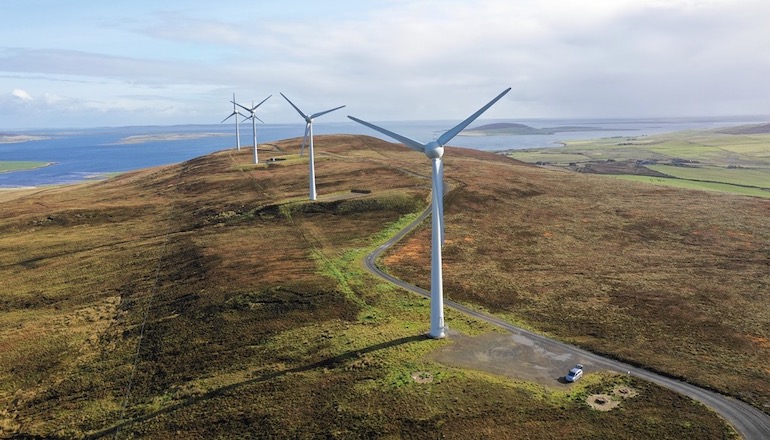
On Orkney a local flexibility market trial has delivered almost peer-to-peer trades between local wind turbines and homes, as well as providing flexibility services into a national energy market.
The two-year trial, known as Project TraDER, aimed to demonstrate the value of flexibility exchanges – operated on a neutral market platform – allowing multiple assets to realise their full value to the energy system.
The assets on the platform include energy storage, demand-side response, and generation.
Orkney was chosen to trial the exchange, due to the high levels of curtailment of renewable generation on the island, a result of constraints in the capacity of the electricity grids between Orkney and the Scottish mainland, and the active network management system already operating in the region.
Project TraDER, led by Electron, was funded via the Department of Business Energy and Industrial Strategy’s FleX fund and supported by CGI, Community Energy Scotland, EDF, Elexon, Energy Systems Catapult and Kaluza, as well as National Grid ESO, and Scottish and Southern Electricity Networks.
It explored how a single energy source – in this case, local wind generation or electric heaters– could access multiple revenue streams by switching trading between local and national energy markets.
The developed platform gave access to new revenue streams for local assets, coordinated local and national actions and improved asset availability for national markets.
Jo-Jo Hubbard, chief executive of Electron, said: “Orkney is one of the windiest places in the UK and wind farms connected to the local distribution network can be asked to turn off if there is too much generation and not enough grid capacity or consumer demand.
“Unlike generators connected to the national transmission network, they get no compensation. So not only do local generators miss out on revenue streams when curtailed, but clean energy is wasted.”
Two products were developed for the Orkney flexibility market to demonstrate how the trading platform would operate.
The first is a local “demand turn up” (DTU) product that enables local generation – two community owned wind turbines run by Community Energy Scotland – to trade during times of high curtailment with 134 homes with electric storage heaters aggregated by Kaluza and two batteries that are part of a parallel project – Reflex Orkney.
The second, ANM Flex, was a national product allowing the distribution connected assets to provide downward flexibility to the ESO, which is currently prohibited as they sit within an ANM zone.
TraDER developed mechanisms for enabling these assets to access national ancillary services thereby improving asset revenues and increasing market efficiency and liquidity.