


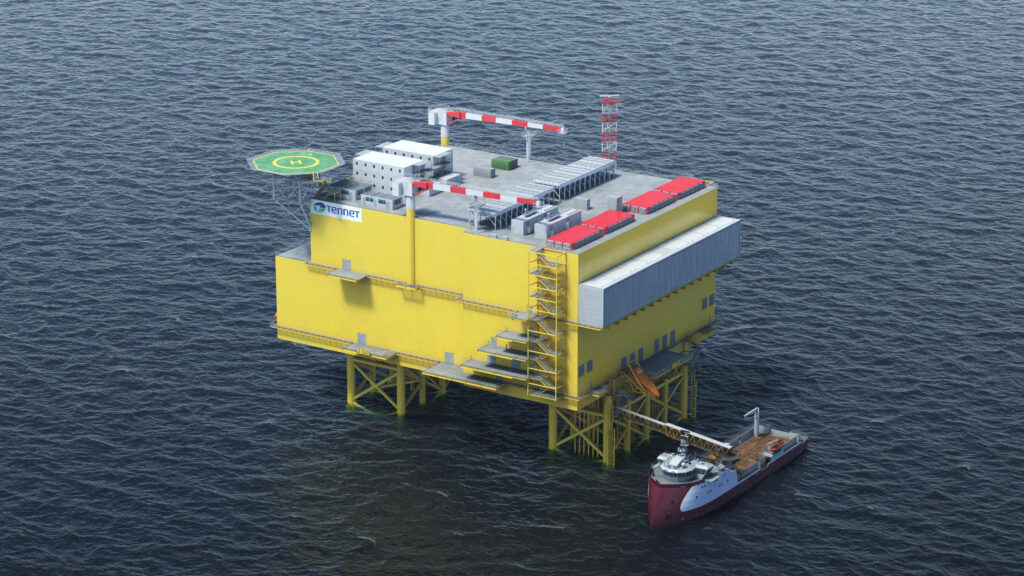
TenneT will launch the first tenders in March for 2GW offshore wind grid connections in the Dutch and German North Seas.
The company said the first tender will cover at least two projects in the IJmuiden Ver Wind area in the Netherlands to be in operation in 2028 and 2029.
In Germany the first projects will be BalWin1, due in operation in 2029, and BalWin2 and 3 for operation in 2030, it said.
The contract will be divided into three parts for the main scope of work.
First, for the offshore platform’s topside and jacket, together with HVDC offshore and onshore converter including HVDC system responsibility.
Second, construction works, building and building services for the onshore station.
Third, the 525kV HVDC cable supply and installation offshore and nearshore.
The onshore cable installation contracting strategy will be decided at a later stage, TenneT said.
TenneT said that these five grid connection projects and the other projects already in development will increase its transmission capacity to approximately 26.3GW in 2030 from 8.5GW now.
It added that 2GW will be the new standard for grid connections that aims to further reduce the costs of offshore wind to minimise the spatial and environmental impact.
“The new 2GW standard will more than double the capacity in comparison with the previous 900MW HVDC standard,” the company added.
The new transmission standard supports its vision towards larger offshore wind farms and a North Sea wide Hub-and-Spoke system, combining wind power connection, coupling of energy markets through interconnection and smart integration into the main onshore grids.
As part of this development, the Dutch IJmuiden Ver projects will be ready to connect a future multi-purpose interconnector, known as WindConnector, to the UK.
TenneT chief operating officer Tim Meyerjurgens said: “Only a massive expansion of offshore wind energy will enable Europe to reach the Paris climate goals, which foresee climate neutrality by 2050.
“TenneT has many years of expertise in offshore grid connections and implements innovative and economical solutions.
“With the new future 525 kV HVDC system with a transmission capacity of 2GW, we are defining the new global benchmark to achieve these goals.”