


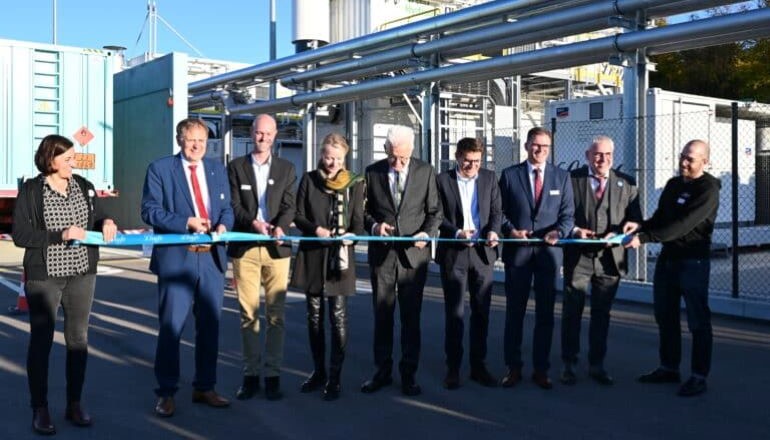
Lhyfe has inaugurated one of Germany’s largest commercial renewable hydrogen production site in Baden-Wurttemberg, marking the company’s first project outside France and its largest facility to date.
The 10MW Schwabisch Gmund site can produce up to 4 tonnes of renewable hydrogen per day through water electrolysis powered by renewable electricity.
Lhyfe said the plant will decarbonise heavy-duty mobility and industry across the region and has already secured power purchase agreements with producers in Germany, including EDPR.
Each modular containerised unit on site handles the full production process, from electricity conversion and electrolysis to purification, compression and filling, with capacity for trucks or tube trailers to deliver hydrogen directly to customers.
The project received €2.1 million from the state of Baden-Württemberg and €4.3 million from the European Regional Development Fund as part of the H2-Wandel model region initiative.
The site obtained RFNBO (Renewable Fuel of Non-Biological Origin) certification in September 2025, the EU’s most stringent renewable hydrogen standard under the Renewable Energy Directive.
Lhyfe said the certification confirms the hydrogen produced is 100% renewable and compliant with EU environmental and traceability criteria, enabling customers to qualify for national and European grant schemes.
Winfried Kretschmann, Minister-President of Baden-Württemberg, said: “With the production site by electrolysis of water in Schwabisch Gmund, Baden-Wurttemberg is taking an important step forward in ramping up hydrogen technology. This flagship project, supported by the state, sends a strong signal: we are ready for a sustainable future.”
Thekla Walker, Minister for the Environment, Climate and Energy, said: “We have to play an important role in the international hydrogen market. To do so, we need to overcome challenges, from infrastructure to costs. We in the state of Baden-Wurttemberg are supporting important projects. One particular example of this is the model region H2-Wandel and the successful completion of electrolyser construction by the company Lhyfe. I am delighted to see such pioneers paving the way to a sustainable and climate-neutral future.”
Dr Joachim Blase, District Administrator of the Ostalbkreis, said: “I am delighted that the first production site by electrolysis of water in the Ostalbkreis has now been inaugurated. With projects such as Lhyfe’s hydrogen hub, companies are venturing into new markets and new technologies. Both come with uncertainty and risk – and for that, we need bold pioneers who show that it can be done.”
Nicolas Gibert-Morin, Head of Unit at the European Commission’s DG REGIO, said: “Through the ERDF, the European Union supports model regions for green hydrogen in Baden-Württemberg, such as here in the Mittlere Alb-Donau-Ostwurttemberg region. This makes perfect sense: developing a green hydrogen economy can boost innovation, create jobs and foster growth across the European Union.”
Richard Arnold, mayor of Schwabisch Gmund, said: “With the opening of the 10 MW water electrolysis production site by the French company Lhyfe, Schwabisch Gmund is becoming a key location for green hydrogen in southern Germany. This new climate-neutral energy carrier enables companies to develop new products and create added value. As part of Baden-Wurttemberg’s Green Hydrogen Model Region, I would like to thank the European Union and the state’s Ministry of the Environment for their support, which made this project possible.”
Luc Grare, head of Central & Eastern Europe at Lhyfe, said: “We are proud to inaugurate Lhyfe’s very first site outside France, here in Baden-Wurttemberg, a state that has continued its efforts in recent years to establish itself as a model for the deployment of renewable hydrogen. With our three units in operation and some of the most advanced logistics in Europe, we have demonstrated our operational capabilities. We are now ready to open a new chapter in Lhyfe’s history in Germany, to deliver ever-increasing volumes and, in the long term, to develop on-site production units to meet the most significant needs, similar to the projects we are already carrying out in several European countries.”