


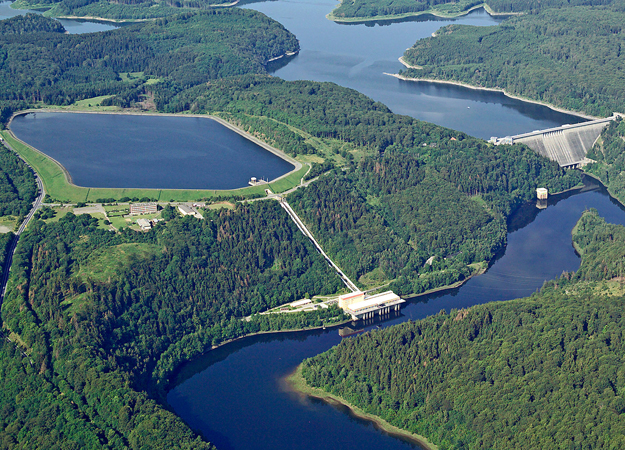
A government-led coalition has urged the world to scale-up long duration storage to support solar and wind to avoid the risk of power system blackouts.
The International Forum on Pumped Storage Hydropower, a coalition of governments worldwide led by the US Department of Energy, the International Hydropower Association (IHA) and involving more than 70 multilateral banks, research institutes, NGOs and public and private companies, warns that conventional batteries alone cannot provide adequate storage and grid flexibility.
“What happens when the sun does not shine and the wind does not blow? These technologies need a low carbon back-up or we will fall back on fossil fuels or simply have to get used to blackouts,” it concluded.
The International Forum has put forward seven recommendations for governments around the world to avert the risk of policy makers and grid operators falling back on fossil fuels to provide clean energy storage.
These include assessing long-term storage needs now, so that the most efficient options, which may take longer to build, are not lost.
The recommendations also ask governments to ensure consistent, technology neutral comparisons between energy storage and flexibility options and remunerate providers of essential electricity grid, storage, and flexibility services as well as support and incentivise pumped storage hydropower in green recovery programmes and green finance mechanisms.
The International Forum was formed 10 months ago in November 2020 to research practical recommendations for governments and markets aimed at addressing the urgent need for green, long-duration energy storage in the clean energy transition.
The initiative is co-chaired by Malcolm Turnbull who as Prime Minister of Australia 2015-2018 oversaw pumped storage hydropower projects, including the 2GW Snowy 2.0 project and the Battery of the Nation initiative.
Turnbull has warned the lack of adequate long duration energy storage to support growing penetrations of solar and wind power is “the ignored crisis within the crisis”.