


The Maritime Future Advisory Board has presented its Maritime Future Concept, a strategic response to the opportunities and challenges Germany’s Mecklenburg-Western Pomerania will face in the next two decades as part of its ecological, economic and social transformation, and contribution to renewables targets.
The board presented its results to Mecklenburg-Western Pomerania’s Prime Minister, Manuela Schwesig, and the state’s Minister of Economic Affairs, Infrastructure, Tourism and Labour Reinhard Meyer.
The concept shows the contribution a strong maritime economy can make to the state and presents goals and measures for an integrated energy, industrial and security transition.
In this way, Mecklenburg-Western Pomerania’s position as a key state for the energy transition, centre of an efficient maritime industry and Germany’s strategic gateway to the Baltic Sea is to be expanded and consolidated.
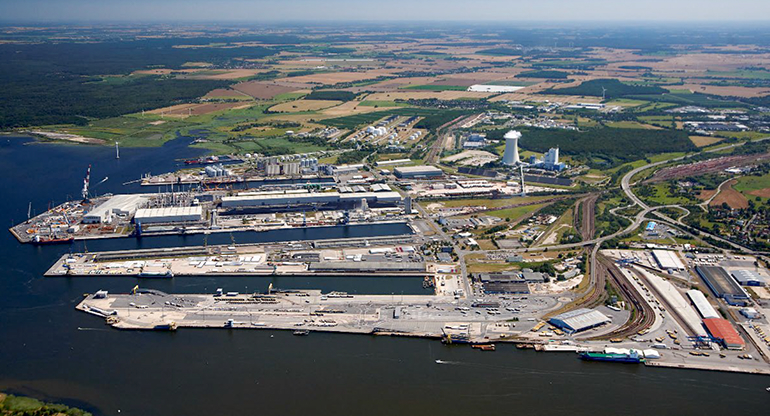
With the expected resettlement of offshore converter construction at the shipyard in Rostock-Warnemünde (pictured), in a hitherto unique co-use of the site with the naval arsenal of the German Armed Forces, as well as the takeover of the Wismar site by TKMS, the state can already build on substantial successes of the recent past, said the report.
In order to overcome the current major challenges, the importance of the shortage of skilled workers and a competitive domestic value chain will also be brought into focus by the findings.
Managing director of the Offshore Windenergie Foundation, member of the Future Advisory Board and head of the workshop Energy Production on the Coast Karina Würtz said: “The maritime industry has been part of Mecklenburg-Vorpommern’s DNA for centuries with enormous innovation, value creation and thus future potential for the entire state.
“The opportunities for coastal locations extend far beyond national maritime borders and far into the Baltic Sea region.
“In order for the identified potential to really be leveraged for Mecklenburg-Western Pomerania, three things are needed: an innovative landscape of actors, binding and verifiable objectives, and an integrated energy and industrial policy at state and federal level.
“The state has the former, as the stakeholder meetings have shown. For the other two points, the future concept provides a strong working basis.”
In order to achieve broad acceptance and to be able to use it for the implementation of the institutional strategy, the most important stakeholders of the state were effectively involved in the development process. On the initiative of the state government, the expertise of representatives of shipyards, the energy and offshore wind industry, the supplier industry, ports, shipping companies, universities and other scientific institutions were included.
The key recommendations in the response are acceleration of planning and approval procedures, planning protection of sufficient areas for the construction of (maritime) energy and industrial infrastructure (land provision), promoting technology transfer between science and industry, and developing political and business relations with the maritime industry.
The document also set out specific objectives for the sub-sectors.
Among them were that ports should focus on safety, have an increase in federal funding and see an expansion of efficient hinterland connections.
For offshore wind, the response called for increased visibility that the expansion of sector energy and the necessary maritime infrastructure are nationwide tasks and responsibilities, securing the industrial capacities required to achieve the expansion targets and stronger networking with EU partners, in particular in the Baltic Sea region.
It also called for an expansion of hydrogen infrastructure, using ports as a locational advantage.