


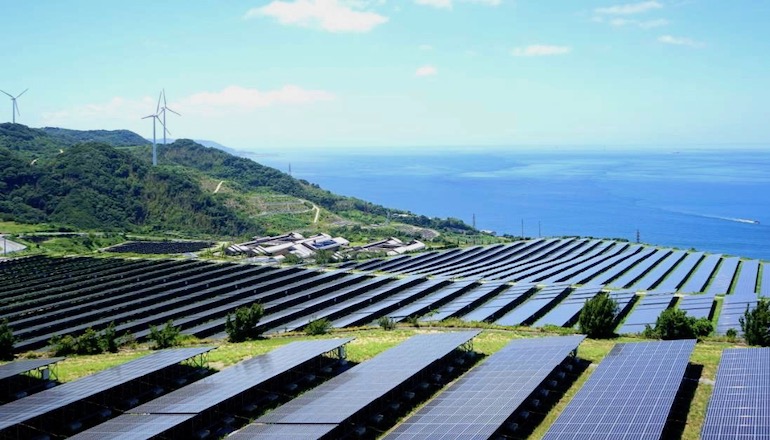
The share of renewable energy that achieved lower costs than the most competitive fossil fuel option doubled in 2020, a new report by the International Renewable Energy Agency (IRENA) has revealed.
Some 162GW, or 62%, of total renewable power generation added last year had lower costs than the cheapest new fossil fuel alternative.
Renewable Power Generation Costs in 2020 shows that costs for renewable technologies continued to “fall significantly” year-on-year.
Concentrating solar power (CSP) fell by 16%, onshore wind by 13%, offshore wind by 9% and solar photovoltaics by 7%.
Renewables increasingly undercut existing coal’s operational costs too, the report found.
The renewable projects added last year will reduce costs in the electricity sector by at least $6bn a year in emerging countries, relative to adding the same amount of fossil fuel-fired generation.
Two-thirds of these savings will come from onshore wind, followed by hydropower and solar PV.
Cost savings come in addition to economic benefits and reduced carbon emissions.
IRENA said low-cost renewables give developed and developing countries a “strong business case to power past coal” in pursuit of a net zero economy.
IRENA director-general Francesco La Camera said: “Today, renewables are the cheapest source of power.
“Renewables present countries tied to coal with an economically attractive phase-out agenda that ensures they meet growing energy demand, while saving costs, adding jobs, boosting growth and meeting climate ambition.
“I am encouraged that more and more countries opt to power their economies with renewables and follow IRENA’s pathway to reach net zero emissions by 2050.”
He added: “We are far beyond the tipping point of coal.
“Following the latest commitment by G7 to net zero and stop global coal funding abroad, it is now for G20 and emerging economies to match these measures.
“We cannot allow having a dual-track for energy transition where some countries rapidly turn green and others remain trapped in the fossil-based system of the past.”
He said “global solidarity” will be crucial, from technology diffusion to financial strategies and investment support to ensure everybody benefits from the energy transition.
The 534GW of renewable capacity added in emerging countries since 2010 at lower costs than the cheapest coal option are reducing electricity costs by around $32bn every year.
Within 10 years, the cost of electricity from utility-scale solar PV fell by 85%, CSP by 68%, onshore wind by 56% and 48% for offshore wind, IRENA found.