


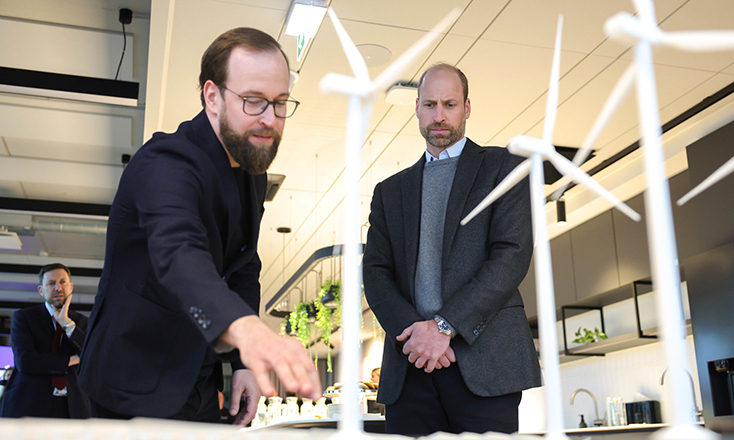
Prince William visited Estonian company Sunly to discuss how hybrid energy parks are strengthening energy security and reducing reliance on Russian fossil fuels.
The visit, part of a tour including meetings with British troops under Nato’s Operation Cabrit, comes weeks after the Baltic states permanently disconnected from the Russian power grid and integrated with the European system.
At Sunly’s offices, Prince William was shown the model for the company’s flagship Risti Energy Park, a €335m investment representing the largest solar installation in the Baltics, which exemplifies their hybrid model.
The 244MW facility combines solar generation and storage and has the infrastructure to integrate wind power.
Once completed, it can cover approximately 7% of Estonia’s total electricity consumption.
Sunly says its hybrid parks address a critical European energy challenge. Despite record renewable generation, much of clean energy goes to waste due to inflexible grids and limited storage capacity.
Last year, Estonia increased its solar power generation by 50%, yet the country saw 236 hours of zero or negative solar electricity prices when supply outstripped demand.
This mirrors challenges faced across Europe, including the UK, where the government paid Scottish wind farms £1bn to shut down wind turbines to prevent the grid from overloading.
For every megawatt wasted, more fossil fuels must be burned, extending dependence on Russian gas.
According to the Centre for Research on Energy and Clean Air, EU countries still paid Russia €1.3bn for fossil fuel imports this February alone, with over half going towards LNG purchases.
The hybrid park concept combines solar, wind and battery storage in a single location to maximise efficiency and eliminate wastage.
Sunly co-founder and chairman Martin Kruus said : “Wind and solar energy are complementary as they peak at different times.
“By co-locating these different energy sources, the overall energy output becomes more stable and increases to 50%, compared to just 15% for solar-only or 30% for standalone wind farms.”
During his visit, the Prince was briefed on how Sunly is working with authorities to implement zonal pricing, allowing businesses and households near energy parks to pay up to 50% less for electricity.
Sunly co-founder and chief executive Priit Lepasepp (pictured with Prince William) said: “The war in Ukraine has demonstrated the vulnerabilities of energy systems reliant on fossil fuel imports.
“What we’re building here isn’t just energy infrastructure – it’s a green shield for national security. Unlike gas, which depends on global supply chains, solar and wind continue generating power even when infrastructure is damaged.
“The Risti Energy Park is designed to maintain a limited power supply even in worst-case scenarios – such as war or extreme weather conditions.”
Prince William’s visit comes days after Sunly secured €62m in financing from the European Investment Bank (EIB) and other investors.