Emission reductions from renewables must be at the heart of any effort to limit a global temperature rise, a report out today has stated.
The REthinking 2015 report, released by the International Renewable Energy Agency (IRENA), states that achieving a 36% share of renewable energy by 2030 would result in half of all emission reduction needed to maintain a two degree Celsius pathway.
It also found that energy efficiency measures could supply the rest.
“The energy sector accounts for more than two-thirds of global greenhouse gas emissions, and therefore must be the focus of climate action,” said IRENA director Adnan Z. Amin. “Transitioning rapidly to a future fuelled by renewable energy, accompanied by increasing energy efficiency, is the most effective way to limit global temperature rise. This transition is underway but it must be accelerated if we are to limit global temperature rise to two degrees Celsius.”
The report states that to achieve a 36% share of total energy, the uptake of renewable energy would need to “increase six-fold” from current levels. This would require global annual investment to nearly double, to “exceed USD 500 billion in the period up to 2020, and more than triple to exceed USD 900 billion from 2021 to 2030.”
The report outlines five actions for a sustainable energy future to make this happen including: strengthening policy commitments, mobilising investments, building institutional capacity, linking renewables to Sustainable Development Goals and enhancing regional engagement.
The report also found that job levels could rise dramatically: “The renewable energy sector employs 7.7 million people worldwide, creating more jobs per unit of electricity generated than coal or natural gas. If a 36 per cent share of renewables is achieved, employment levels could exceed 24 million jobs by 2030.”
Amin continued: “The strong business case for renewable energy has made the energy transition inevitable. It is now not a question of if the world ultimately transitions to a renewable energy future, but rather whether it will do so quickly enough. At the upcoming climate talks in Paris, it will be up to countries to commit to strong targets, and in turn, give a strong political signal to catalyse further investments in renewable energy.”
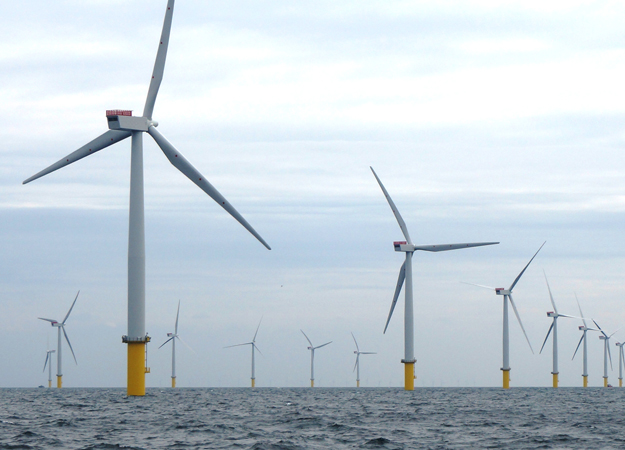
Image: Gwynt y Mor offshore wind farm (RWE)
RE ‘at heart’ of climate talks
IRENA report states industry must be the 'focus' to limit temperature rise
 By EBS