


2023 saw the highest-ever increase in renewable energy jobs, according to a review by the International Renewable Energy Agency (IRENA) and the International Labour Organization (ILO).
Between 2022 and 2023 jobs in the global renewables sector rose from 13.7 million to 16.2 million with the 18% year-on-year leap reflecting the strong growth of renewables generating capacities, together with a continued expansion of equipment manufacturing.
China leads with an estimated 7.4 million renewable energy jobs, or 46% of the global total.
The EU followed suit with 1.8 million, Brazil with 1.56 million, and the United States and India, each with close to a million jobs.
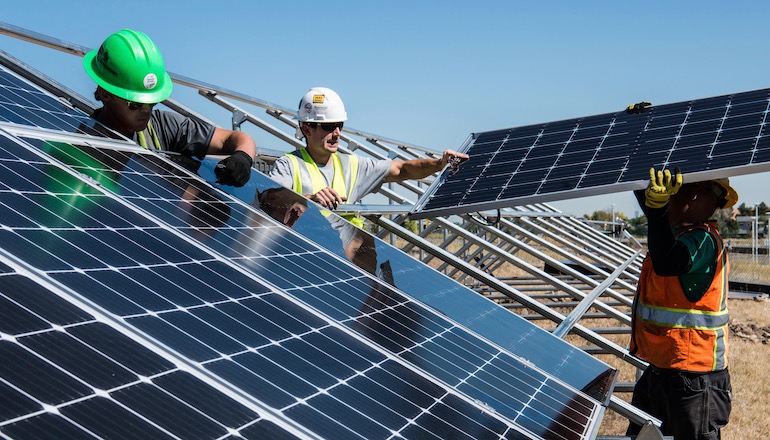
As in the past few years, the strongest impetus came from the rapidly growing solar photovoltaics sector, which supported 7.2 million jobs globally.
Of these, 4.6 million were in China, the dominant PV manufacturer and installer.
Enabled by significant Chinese investments, south-east Asia has emerged as an important export hub of solar, creating jobs in the region.
Liquid biofuels had the second-largest number of jobs, followed by hydropower and wind.
Brazil topped the biofuels ranks, accounting for one third of the world’s 2.8 million jobs in this sector.
Soaring production put Indonesia in second, with a quarter of global biofuels jobs.
Due to a slowdown in deployment, hydropower became an outlier to the overall growth trend, with the number of direct jobs estimated to have shrunk from 2.5 million in 2022 to 2.3 million.
China, India, Brazil, Vietnam and Pakistan were the largest employers in the industry.
In the wind sector, China and Europe remain dominant.
As leaders in turbine manufacturing and installations, they contributed 52% and 21% to the global total of 1.5 million jobs, respectively.
Despite immense resource potential, Africa continues to receive only a small share of global renewables investments, which translated into a total of 324,000 renewables jobs in 2023.
ILO director general Gilbert Houngbo said: “Investing in education, skills, and training helps reskill all workers from fossil fuel sectors, address gender or other disparities, and prepare the workforce for new clean energy roles.
“It is essential if we are to equip workers with the knowledge and skills that they need to get decent jobs, and to ensure that the energy transition is a just and sustainable one.
“A sustainable transition is what the Paris Agreement requires of us, and what we committed to achieving when we signed up to the agreement.”