


The Scottish government needs to start delivering on its climate promises in order to meet its net-zero emissions goals, according to a new report from the UK’s Climate Change Committee (CCC).
CCC said Scotland’s annual emissions target was missed in 2019, followed by a pandemic-driven fall in 2020 that is likely to be only “transitory”.
It added that future annual targets will also be difficult to meet, but Ministers must try to prevent the gap to their achievement widening further.
To get on track, the focus must be on the transition to net zero, delivering the major changes required for Scotland’s 2030, 2040 and 2045 milestone targets, CCC said.
The Scotland Climate Change Plan update provides ambitious and stretching pathways for emissions reductions in key sectors, the committee said.
“In critical areas of low carbon transport and heating, Scottish levels of ambition are now higher than the rest of the UK, but it has not been possible to determine how promised policies will deliver these laudable ambitions, nor how funding will be allocated to their delivery,” CCC said.
CCC’s ‘Progress in reducing emissions in Scotland: 2021 Report to Parliament’ report provides more than 70 recommendations to support Scotland in its energy transition.
Reaching net zero will now require the Scottish and UK governments to work together to deliver specific decarbonisation solutions in Scotland, the committee said.
For agriculture and greenhouse gas removals, there are still uncertainties.
There is still an urgent need to define a low-carbon agriculture policy to replace the Common Agricultural Policy.
CCC said a significant proportion of the Scottish government’s ambition for 2030 rests on carbon capture and storage (CCS), but with the Scottish CCS cluster announced as only a ‘reserve project’, a decision must be made about whether to continue to plan for CCS and removals to contribute to the 2030 target at the same scale.
The committee said the risks to meeting the 2030 interim emissions target are now acute, ambition must increase in those areas where rapid changes are still feasible, or where it is possible to lock in lower emissions after the pandemic.
Peatland restoration could occur at a significantly higher rate than that committed to by the Scottish government, it said.
Reduction in consumption of meat and dairy can improve the health of Scottish citizens and contribute to Scotland’s emissions targets.
And none of the recent policy documents or consultations has set out an explicit intent to limit aviation demand growth, CCC added.
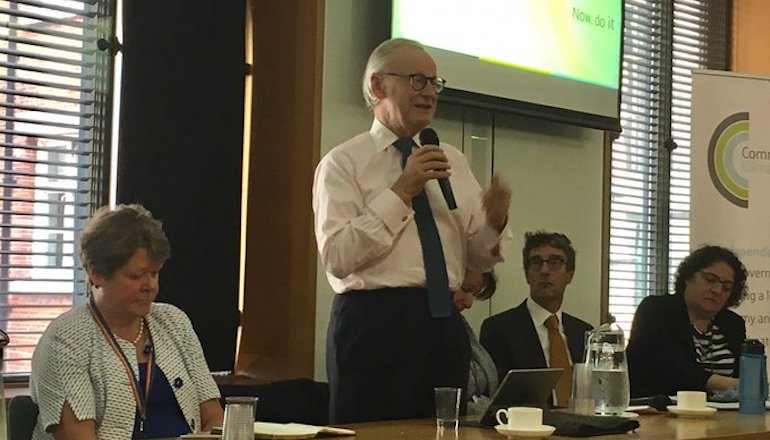
CCC chair Lord Deben (pictured) said: “Scotland’s successful hosting of COP26 makes it particularly important for the Scottish Government to respond to the new Glasgow Climate Pact and show how serious it is about delivering Net Zero. Strategies alone won’t reduce emissions.
“Major changes are needed across the Scottish economy, requiring lasting, systemic action in most sectors.
“Clarity and transparency on policy, supported with detail on how these policies will be delivered has been lacking. My Committee cannot assess future progress without this vital assurance.”