


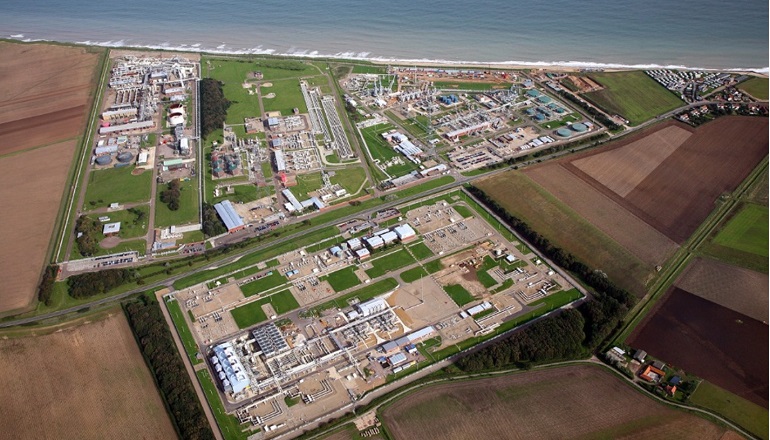
A research study has begun to explore the potential for green hydrogen production off the coast of East Anglia, in the UK.
The study, led by Hydrogen East, will research options and scenarios to bring together the region’s offshore gas and offshore wind sectors to produce clean hydrogen at scale for cleaner power, heat and transport fuels supplying the region and beyond.
The ‘Bacton Energy Hub: Exploring the potential for hydrogen from the Southern North Sea’ study will map existing offshore and onshore energy-related infrastructure and develop options and scenarios for where wind farms, gas platforms, subsea pipelines and cables could be integrated or repurposed over time to support hydrogen production.
The Bacton terminal on North Norfolk’s coast will potentially be used for injection into the gas grid.
The UK Government is due to publish a UK Hydrogen Strategy later this year which this regional study will help to inform, Hydrogen East said.
Recent regional announcements are also highlighting a significant role for hydrogen such as plans for a hydrogen hub as part of the Freeports East bid led by the ports of Felixstowe and Harwich, supported by EDF Energy, Sizewell C, Ryse Hydrogen, JCB, New Anglia and South East Local Enterprise Partnerships, and many other partners including Hydrogen East.
The study is being co-funded by the Oil and Gas Technology Centre (OGTC), the Offshore Renewable Energy Catapult, New Anglia Local Enterprise Partnership, and North Norfolk District Council, with support from New Anglia Energy, Opergy, and Xodus Group.
Nigel Cornwall, co-founder of Hydrogen East and a director at New Anglia Energy, said: “Developing the options for a potential Bacton Energy Hub will help to facilitate and accelerate the transition towards net zero emissions.
“It is a key regional project, which could realise extensive potential benefits both in terms of supporting delivery of the Local Industrial Strategy and the stated aim of enabling Norfolk and Suffolk to become the UK’s Clean Growth Region.
“It will contribute to Hydrogen East’s driving objective of Norfolk and Suffolk becoming a significant regional hydrogen economy.
The study is the first phase of a potential three-part project, comprising scoping, indicative market assessment, and initial feasibility and options study, options development, detailed project definition and concept engineering studies.
It will end with the establishment of demonstration projects with funding and partnering arrangements, supported by a detailed net zero-based engineering pathway for the Bacton Energy Hub.