


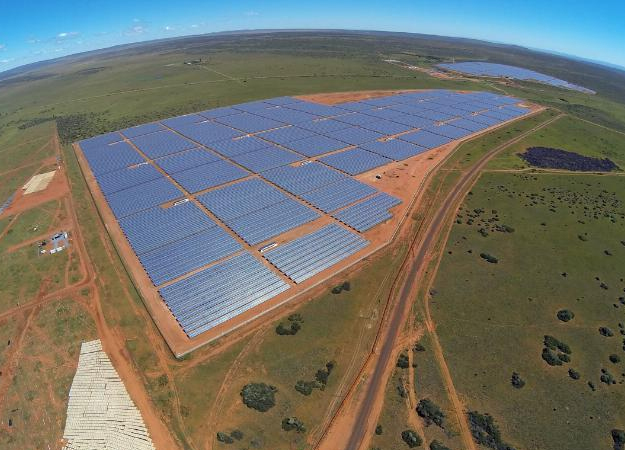
A new report found just under $3bn was spent on renewables projects in 2018 in sub-Saharan Africa, excluding South Africa, a regional record.
According to Bloomberg New Energy Finance’s (BNEF) Sub-Saharan Africa Market Outlook, published with support from the Department for International Development (DFID) in the UK, investors are increasingly building projects outside of mature markets such as South Africa.
According to the outlook, some 1.2GW of PV capacity is expected to come online in 2021 outside of South Africa, more than twice the amount commissioned in 2018.
Country-level targets and incentives are backed by assistance from multilaterals, which remain a key source of finance and have helped roll out renewable energy auction programmes, according to BNEF, citing the World Bank’s ‘Scaling Solar’ programme, as one example.
The programme recently awarded just under 400MW of solar photovoltaic capacity over 2015-18, equivalent to 39% of the total installed outside of South Africa over the same period.
Such auctions have yielded some of the world’s lowest bid prices for solar power – several projects have won capacity at prices under $0.04 per kilowatt hour.
However, such auctions are “double-edged”, according to the analyst. Many are bundled with features designed to reduce project costs and risk, such as pre-secured sites. BNEF analyst Antoine Vagneur-Jones said, “that helps lower prices, but can also lead to government expecting to procure power at the same rates for projects that are not backed by such frameworks.”
The report identifies other hurdles. Several sub-Saharan African countries sport an “apparent surplus” in installed power generation capacity, which taken at face value, can weaken the case for adding renewables.
Plant availability issues and transmission constraints mean that the gap between supply and demand is often less clear than it would seem, BNEF found.
A prevalence of take-or-pay contracts means that producers are remunerated for power that is not consumed. Whether by attempting to terminate or renegotiate contracts, governments are striving to reduce their obligations in countries such as Ghana, Kenya and South Africa.
Achieving clarity on how to balance future clean energy investments with procurement agreements will be vital if the clean energy is to grow at scale, said the outlook.
The development of regional power markets will allow countries to move beyond such bilateral agreements.
Power has long been traded in southern Africa, and “nascent” power pools in eastern and western Africa will enable countries to exchange surplus electricity across their borders. But a “lack” of private investment in transmission infrastructure, concentrated power markets and small generation fleets will “hinder” their growth, according to BNEF.