


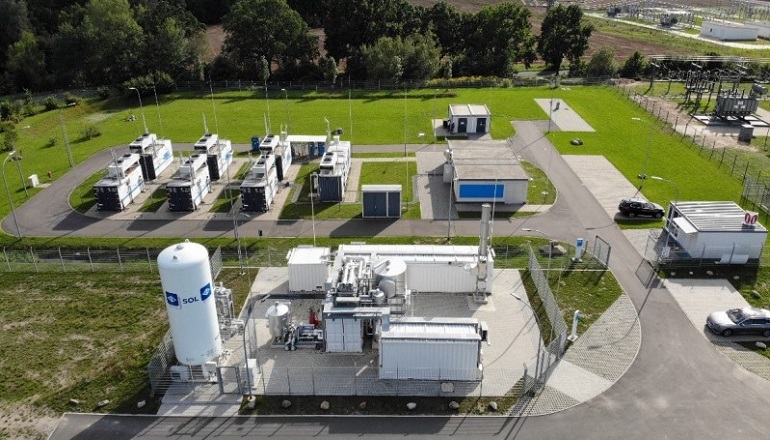
Uniper has entered into an agreement to supply German steel producer Salzgitter with green hydrogen to produce low carbon steel.
Salzgitter, one of Europe’s largest steel producers, will use green hydrogen from Uniper’s site in Wilhelmshaven where it is developing two projects in parallel for the supply of the gas.
The first project is a planned import terminal capable of converting green ammonia back into hydrogen.
The second is a planned electrolysis plant, with a capacity of up to 1GW, with the potential for a direct connection to an offshore wind farm, to be built in the North Sea.
The electrolysis plant and the entire downstream hydrogen infrastructure would function in a similar way to a “shock absorber”, Uniper stated, which would store energy from wind when output is highest, by conversion into hydrogen which can be transportable.
The aim would be to supply Salzgitter through the evolving German hydrogen pipeline network and for the development of cavern storage facilities.
Uniper stated the two companies will “drive the ambitious vision” of decarbonising Germany’s industry in support of the climate targets by contributing to this objective with specific projects.
Gunnar Groebler, at Salzgitter, said: “We are aligning Salzgitter AG to low CO2 production processes and the circular economy.
“The secure and economically viable sourcing of green hydrogen is a fundamental prerequisite on our journey toward SALCOS – Salzgitter Low CO2-Steelmaking.
“The cooperation with Uniper is another step on the way to leading this game-changing technical transformation to success, together with strong partners.”
Uniper chief executive Klaus-Dieter Maubach added: “We need ‘green electrons’ and ‘green molecules’, if we want to achieve the proclaimed climate protection objectives, while preserving our industry in Germany.
“The Wilhelmshaven site offers all the necessary preconditions for creating Germany’s first major hydrogen hub.
“Large-scale hydrogen production facilities are to be built here for the purpose of decarbonizing steel production in Lower Saxony.
“We also want to develop a solution that will enable the faster integration of the new gigawatt offshore wind farm into the German power grid.”
Separately Uniper is also turning the site of its coal fired power plant in Gelsenkirchen-Scholven into an innovation hub for hydrogen technology.
The H2iRTC project (Hydrogen Industrial Research and Training Center) will be specifically designed to address industry needs.
“Research needs to be carried out on issues such as converting hydrogen back into electricity, solving electricity generation problems during low wind and low PV periods and using molecular hydrogen in mobility.
“The aim is to demonstrate and further develop these synergies using applications such as pilot projects that drive technological advancement,” said Bernhard Scholtissek, H2iRTC project manager at Uniper Hydrogen.