


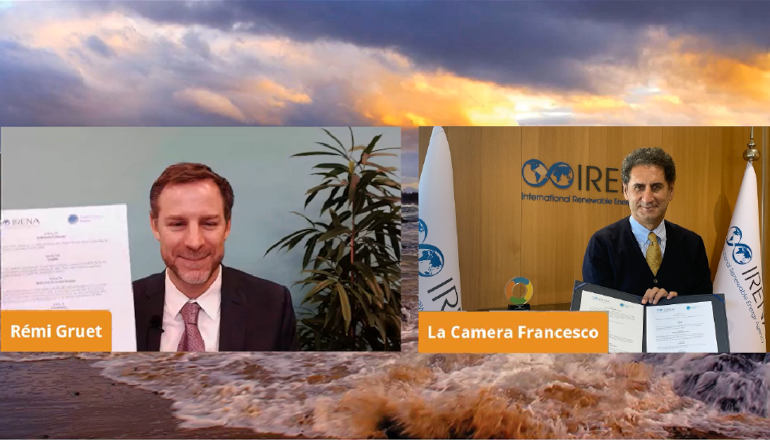
Ocean Energy Europe (OEE) and the International Renewable Energy Agency have agreed a new partnership to deepen cooperation in ocean energy technologies.
It is targeting new policy incentives and innovative business models in Europe and globally.
OEE chief executive Rémi Gruet and IRENA director-general Francesco La Camera (pictured) signed a Memorandum of Understanding today at the annual Ocean Energy Europe Conference & Exhibition.
Oceans hold abundant, largely untapped renewable energy potential that could drive a vigorous global blue economy according to two new studies, also released today by IRENA.
‘Fostering a blue economy: Offshore renewable energy’ and the Agency’s ‘Innovation outlook: Ocean energy technologies’ find that in addition to providing mainstream power generation, a blue economy driven by offshore renewables will bring major benefits to Small Island Developing States (SIDS) and coastal communities.
Today, ocean energy accounts for approximately 530MW of installed generation capacity globally.
Tidal stream and wave projects currently under construction may add another 3GW of installed capacity short-term within the next 5 years, most of it in Europe (55%) , Asia-Pacific (28%) and the Middle East and Africa (13%).
However, with the right incentives and regulatory frameworks in place, IRENA foresees the potential growth of ocean energy up to 10GW of installed capacity by 2030 globally.
Ocean energy can not only help to decarbonise power generation, provide affordable and reliable access to electricity, help countries to fulfil Paris Agreement pledges and contribute to global climate action.
Offshore renewables can help meet energy needs for shipping, cooling and water desalination, laying the foundation for a broad-based blue economy and industry, the reports argue.
They create jobs, improve health, strengthen people’s livelihoods and foster wider socioeconomic opportunities for a green recovery from COVID-19.
La Camera added: “Renewable energy from oceans has the potential to meet four times the global electricity demand of today, foster a blue economy, and bring socio-economic benefits to some of the most vulnerable areas to climate change such as SIDS and coastal areas.
“Close cooperation with OEE in platforms like IRENA’s Collaborative Framework and Coalition for Action is absolutely vital to share knowledge with industry to ensure a widespread deployment of ocean and offshore renewables in the future.”
Gruet added: “We have enjoyed a fruitful collaboration between OEE and IRENA for some time, and I am delighted to formalise it today.
“Europe is a world-leader in the development of ocean energy, but the massive potential of these technologies is unarguably global in scale. Working on joint initiatives and exchanging information with IRENA will strengthen the advancement of these technologies on the international stage.”
Following the steps of wind power and solar PV, innovative offshore renewables have seen huge cost reductions in recent years and tidal and wave energy already offer a viable alternative for remote diesel-powered island territories with high electricity costs, the organisations said.
Strong R&I programs, revenue support, and regional co-operation in marine spatial planning are now needed to bring these technologies to the commercial stage, they added.