


US company ORPC is partnering with non-profit organisation Our Katahdin to create a testing centre at One North, the former Great Northern Paper Mill site, to support the next-generation design and development of the former’s river hydro-kinetic power system.
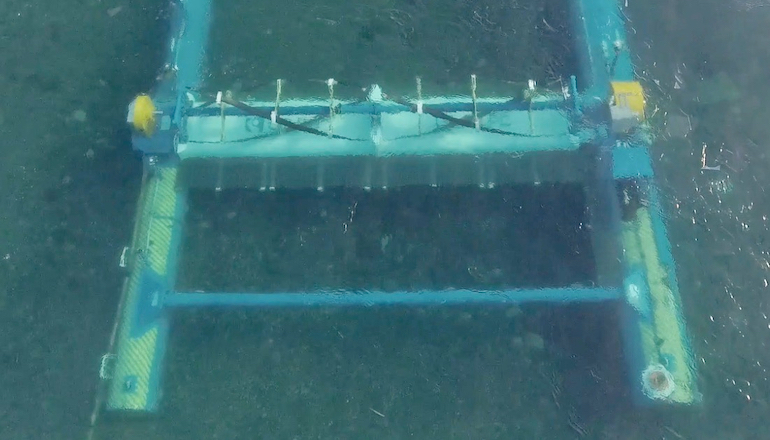
ORPC will assemble, test and showcase at Millinocket in the US state of Maine a smaller version of its commercialised RivGen device (pictured) called Modular RivGen.
Modular RivGen is designed for use in grid-connected markets, with applications for large rivers, electrical vehicle (EV) charging networks, hydroelectric facilities, irrigation canals and bridges, piers, breakwaters and flood controls systems.
The company secured funding from the US Department of Energy’s Water Power Technologies Office to help initiate associated product and market development.
It will begin product testing later this year in Millinocket Stream adjacent to the former mill property.
ORPC will also work with Our Katahdin on evaluating the site as a future production facility and showroom space in addition to contemporary hydro-kinetic testing facility infrastructure and demonstration of use cases such as EV charging.
Our Katahdin board president Sean DeWitt said: “We welcome ORPC to the portfolio of innovative businesses working with Our Katahdin to help transform, grow and improve the greater Katahdin region’s economy.
“Our partnership with ORPC is yet another example of our area’s suitability for new economic opportunities related to innovative technologies.”
ORPC chief executive Stuart Davies said: “Our expansion into Millinocket provides ORPC with a second Maine product development site, complementing our successful and on-going tidal energy product development activities in Eastport.
“Our company is expanding its footprint in Maine and adding jobs. Securing the partnership with Our Katahdin helps strengthen ORPC’s strategy for market growth ahead.”
In 2021, ORPC’s RivGen power system, operated in partnership with the Village of Igiugig, Alaska.
The project provides baseload renewable power from the free-flowing Kvichak River to the remote community.
In 2022, with the addition of a second RivGen device, smart grid controls and a battery energy storage system, Igiugig will reduce its diesel use by 60 to 90%.