


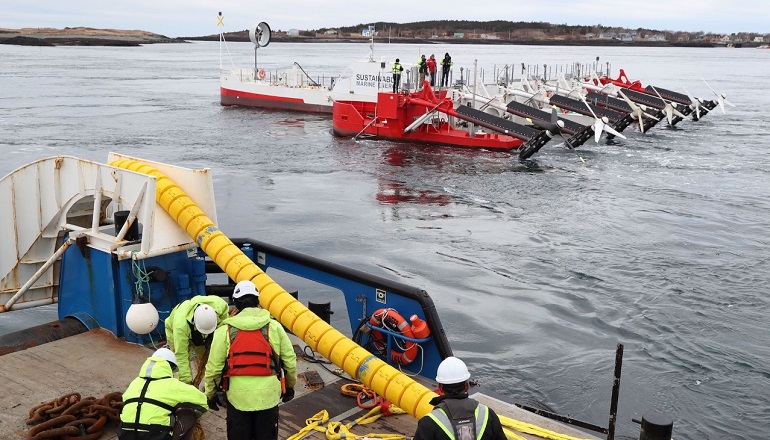
Schottel Hydro, Sustainable Marine’s German engineering partner, has completed testing of a new generation tidal turbine drivetrain at the at RWTH Aachen University, in Germany.
Schottel’s SIT250 drivetrain is a key component in Sustainable Marine’s floating tidal turbine, needed to convert torque – blade rotation – into electricity.
The accelerated lifetime testing was completed in a six-month period, replicating five years of operation in the Minas Passage, Bay of Fundy, Nova Scotia, Canada.
The passage has the highest tides on earth.
The site will host Sustainable Marine’s Pempa’q project involving the world’s first floating tidal energy array, delivering up to 9MW of energy to Nova Scotia’s grid.
A tailor-made test rig was built within the university’s Center for Wind Power Drives (CWD), to test the drivetrain.
It formed part of the “OsT” project, led by Schottel and funded by the German Federal Ministry for Economic Affairs and Energy.
“Our latest testing project with Aachen University marks another significant step forward for our tidal energy technology and the broader Pempa’q Project,” said Ralf Starzmann, vice president of business development at Sustainable Marine.
“Rigorous independent assessments with world-class institutes like Aachen University play a key role providing credibility and confidence in the technology,” he added.
Sustainable Marine’s SIT250 drivetrain has a grid-ready electrical power rating of 70kW.
The system consists of a rotor hub, slow speed shaft, planetary gearbox and asynchronous generator.
As part of the test procedure a total of four independent hydraulic cylinders were used to apply simultaneous testing involving multiple load components.
A 125kW motor was used to substitute the torque generated by the rotor.
Following 2467 hours on the test rig, 152MWh of electrical energy was fed back by the drivetrain, equating to around one year’s electricity supply for 50 German homes.
Post testing the drivetrain was decommissioned and subjected to a thorough inspection.