


A project aiming to maximise tidal energy generation has been launched at University of Edinburgh’s FastBlade facility.
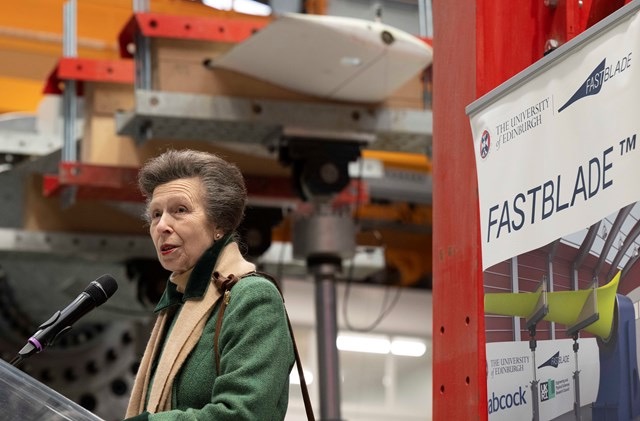
The €10m MAXBlade development – funded by the European Union and UK Research and Innovation – was launched in the presence of Her Royal Highness, The Princess Royal (pictured).
The project aims to deliver a range of innovations to improve the performance of turbines and reduce costs.
It will investigate the lifecycle of tidal turbine blades, from materials, manufacture and operation, to decommissioning and recyclability.
The project’s long-term aim is to ensure the European composite sector becomes the international leader in tidal blade manufacture.
It plans to increase the area harnessed by Orbital Marine Power to generate energy – known as the rotor swept area – by 70%, to more than 1,000 square metres.
MAXBlade will increase the length of the turbine blades from 10 metres to 13 metres – making them the longest of their kind in the world.
The team says that boosting blade length will have the single greatest impact on reducing the cost of tidal energy.
Modelling by the University of Edinburgh’s Institute of Energy Systems estimates £40bn could be generated for the UK economy by harnessing wave and tidal power.
The project will involve a two-year design and development phase, followed by an 18-month build, during which blades will undergo advanced structural testing at FastBlade.
The technology will then face two years of real-world trials at the European Marine Energy Centre (EMEC) in Orkney.
Two of Orbital Marine Power’s O2 floating platforms – the world’s most powerful tidal turbines – will each be fitted with four of the newly developed blades.
The team aims to generate 120,000 hours of performance data that will be assessed by EMEC and project partner TECNALIA, a research and technological development centre.
Innovations from MAXBlade will be integrated with findings from its sister project, FORWARD2030, to enable large-scale production of Orbital’s O2 turbine technology.
This will pave the way to the tidal sector making significant contributions towards Europe’s power systems, energy security and industrial development by 2030 and beyond to 2050, the team said.
Andrew Scott, chief executive at Orbital Marine Power said: “Orbital is delighted to be involved with so many great partners on this cutting-edge project.
“MAXBlade will help deliver tidal energy into a future, low-carbon energy mix at lower costs while, at the same time, position UK & European businesses to benefit from long-term industrial opportunities that will come from this new, sustainable industry.”
Professor Conchúr Ó Brádaigh, head of school and chair of materials engineering at Edinburgh University said: “The University of Edinburgh is delighted to be a partner in the MAXBlade project, where we will demonstrate the unique rapid testing capability of the FastBlade facility.
“This will help the tidal sector to de-risk their ongoing turbine developments and provide low-cost, reliable renewable energy to the grid.
“We will also lead the development of thermoplastic resins in MAXBlade and the circular economy roadmap needed for future tidal blade manufacturing and recycling.”
MAXBlade is led by TechnipFMC and includes Orbital Marine Power, Marasoft, TECNALIA, University of Edinburgh, EMEC, Laborelec and European Composites Industry Association.
It is supported by Edinburgh Innovations, the University of Edinburgh’s commercialisation service.