


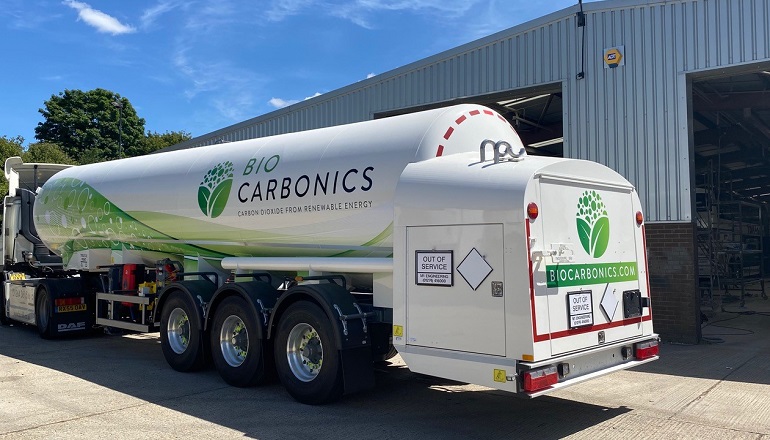
Owners and operators of anaerobic digestion plants injecting biomethane to into the grid could benefit from carbon capture and utilisation (CCU) to take sequestered carbon dioxide (CO2) to market.
Green CO2 produced from biogas has a higher reliability of supply and is a more sustainable product than CO2 traditionally sourced from fossil fuels.
BioCarbonics, a new player in the UK CO2 industry, is working with biogas owners to capture and process their CO2 stream to produce a food and beverage quality liquid CO2 , for use by local businesses.
“And because we have a growing number of highly reliable plants operating around the clock, with a managed maintenance schedule, we are the only business that can offer continuity of supply to customers and no hidden surcharges,” said Christopher Carson, BioCarbonics’ managing director.
He said the company’s carbon capture model is “totally unique” in that it supports plant owners from conceptual design through installation and start-up of their CO2 plants.
BioCarbonics works with clients to install and operate quality systems and equipment that ensures their product meets the food and beverage quality certification.
“We are actively seeking biogas owners who inject renewable methane into the gas grid to work with us and expand our sustainable supply model further,” said Carson.
Hereford biogas plant owner, Nicholas Layton of STL Energy, who has been working with BioCarbonics for a number of years, says there are many benefits to capturing CO2 from biogas installations.
“Capturing this CO2 for use in other applications is much more sustainable than directly releasing it into the atmosphere, and it helps local CO2 users, such as food and drinks producers.
“The multiple plant model delivers a reliable supply chain, and the guidance and advice provided by the BioCarbonics team has been second to none.
“We didn’t have the expertise or knowledge required to enter into the CO2 business on our own, and BioCarbonics gave us the support and training we needed to be able to do this successfully.
“In our sustainability reporting for the plant, the carbon capture means that the emissions effectively become negative across all of our feedstocks, and the RHI eligibility has never been in question.”
One of the customers STL Energy works with is Westons Cider, which supplies the biogas plant with apple pomace, a by-product from apple pressing, and uses BioCarbonics’ CO2 to carbonate its drinks, also a by-product, leading to a great circular model,” added Carson.
Westons Cider purchasing manager Maddy Spencer said: “Before working with STL Energy and BioCarbonics, we had CO2 supply issues.
“Now, from the circa 29,500 tonnes of cider apples we press annually, around 5500 tonnes of pomace will be turned into CO2 and used to carbonate our products.”