


Archaeologists working for Vattenfall on the development of the 1800MW Norfolk Boreas offshore wind farm have recovered evidence of the submerged Doggerland landscape, which was flooded by rising seas more than 8000 years ago.
Wessex Archaeology are conducting the research for the project, off the east coast of England, which they hope will tell a more detailed story of Doggerland.
Cores were recently extracted by borehole drilling from the seabed as part of the developer’s surveys for Boreas that will help to answer questions about the environments in which our ancestors lived.
The research is also hoped to shed light on how quickly they would have needed to adapt to the changing coastline, as rising sea levels flooded the North Sea through the English Channel and cut off the British Isles from the European mainland.
The cores provide an almost unbroken record of pre-historic environmental change from the end of the last Ice Age through to the flooding of Doggerland, according to Wessex Archaeology.
Wessex Archaeology principal marine geoarchaeologist Claire Mellett said: “We have been extremely fortunate to recover what we believe is a unique sequence of sediments which offer an environmental record over a period of nearly 3500 years.”
Full analysis of the samples is now underway, with the results expected in spring 2019.
Mellett said: “There are so many insights that the collected material can give us. We will be able to reveal how the landscape may have looked, how it changed as the climate warmed and sea-levels rose after the last ice age, and – crucially – how this changed the relationship between prehistoric communities and their environment.
“Previously studied peats from this area are from isolated deposits or only capture a short time period.
“Those recorded here however provide a near-continuous record of prehistoric change before and during the flooding of what we now call the English Channel and southern North Sea.
“The data shows that they are also by far the most extensive deposits mapped in Doggerland, covering an area of around 85 square km.”
Historic England, the public body which advises on coastal and marine development projects, is also advising Vattenfall.
Historic England head of marine planning Christopher Pater said: “We are pleased to be working with Vattenfall, who are helping, through this project to throw new light on the extraordinary archaeological history of the North Sea.
“This work has huge potential to show us the changes in climate that have occurred since prehistoric times, and tell us more about the ancient landscape on which our ancestors once roamed.
“We look forward to seeing the results of further investigation and analysis as survey exploration continues, so that we can learn more about how and when land became sea.”
Vattenfall project manager for Norfolk Boreas offshore wind farm Graham Davey said: “It is common that wind farm development – on and offshore – uncovers Britain’s hidden history but important finds like these are exceptionally rare.
“When it does it happen, it’s important to let science take its course and allow a full analysis of the evidence.
“Most fascinating is trying to understand what the data can tell us about how warming over 10,000 years ago affected the landscape and the seascape in the North Sea, and what impacts we might expect from global warming now.”
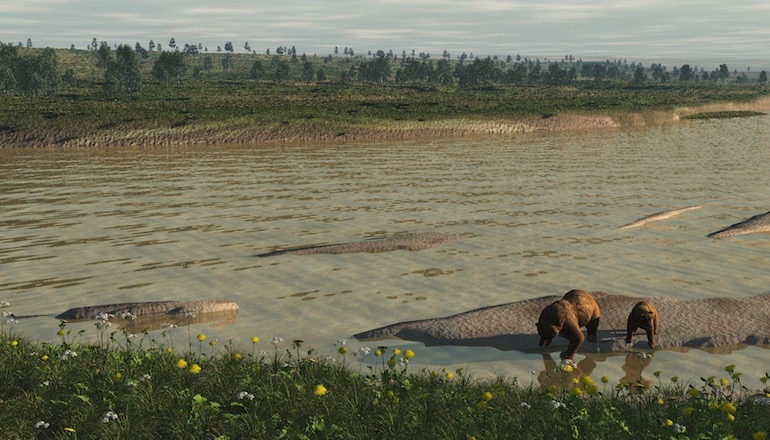
Archaeologists already have some understanding of the Doggerland environment. During the last ice age, about 18,000 years ago, the majority of Britain was covered by ice but, as the climate warmed, Doggerland offered an increasingly attractive environment for human settlement.
Temperate grassland replaced the frozen tundra and big game animals, such as mammoth, aurochs and red deer, attracted hunters to the region.
But as the global climate continued to warm, sea levels rose and Doggerland became a land of rivers and inlets, archipelagos, lagoons, wetlands and marshes.
As woodlands and other flora flourished so did the range of mammals; fish and birds supported Mesolithic communities and populated some of the richest hunting and fishing grounds in Europe.