


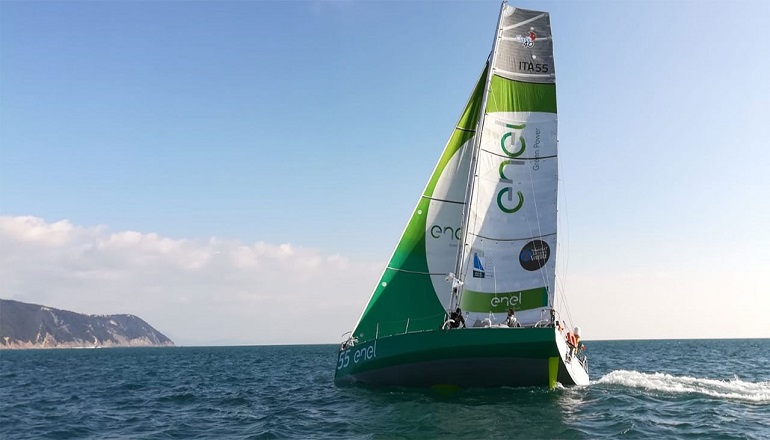
Enel Green Power has teamed up with Italian sailor Andrea Fantini on a clean powered sailing boat that will take part in the transatlantic Route du Rhum race.
The race, which first took place in 1978, occurs every four years and connects Saint-Malo in France with Pointe-à-Pitre, in Guadalupe, in the Caribbean.
On 4 November, for the race’s fortieth anniversary, the canon will sound to start the eleventh competition, which will see over 100 boats, divided into six classes, on the starting line.
The journey of about 6559km will provide a technological and athletic challenge for Fantini, who is an ambassador of sustainability. He is the only Italian to compete in the Class 40, which is the most crowded of the six categories of the race, with more than 50 entries.
Enel Green Power, as innovation partner of the Andrea Fantini team, equipped the Class 40 with a mini-grid, which combines energy produced by solar panels, a wind turbine and a hydrogenerator with a storage system.
The on-board monitoring system can send, in real time, data on energy production and consumption, to give technicians a chance to study and apply the most suitable solutions.
Enel Green Power chief executive Antonio Cammisecra said: “The technological partnership with the Andrea Fantini Racing team allows us to capitalise on our experience in the development of sustainable and innovative energy solutions and, at the same time, show the great potential of renewables to a vast audience of sailing enthusiasts.”
The first part of the Route du Rhum takes place in the heart of winter in the north Atlantic. Strong wind and icy water will force sailors to find the best compromise between speed and the need to conserve themselves, their boats and equipment. Once past Portugal, weather conditions will improve thanks to trade winds.
Fantini said: “There are many hidden dangers in a race like the Route du Rhum. On the other hand, it’s a solo regatta, which means you have to sail fast to get ahead of your adversaries, make a weather-based strategy by studying its changes many times a day, and in the meantime you have to eat, sleep, take photos and videos, fix everything that breaks … basically, there aren’t enough hours in a day.”