


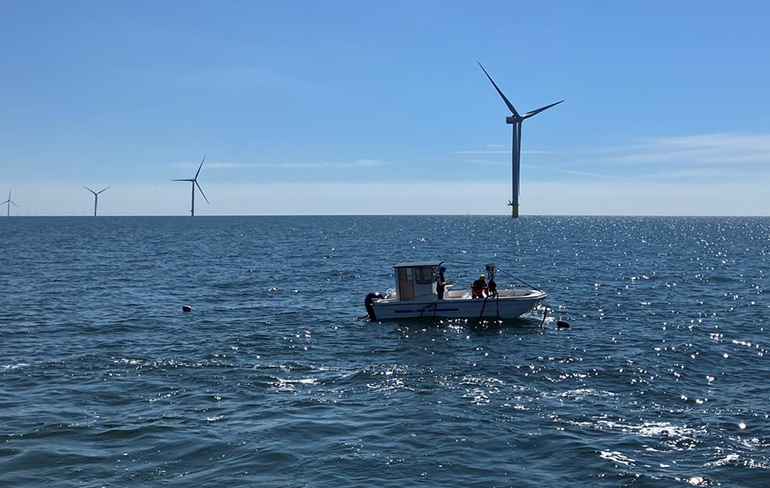
With the increasing competition for space at sea, seaweed and mussel farming between turbines will likely become reality in the future and a new study shows how it is possible to use offshore wind farms to produce food, while meeting the renewable energy needs of northern Europe.
The WIN@sea research collaboration between Danish universities, mussel and seaweed producers, the Kattegatcentre and Vattenfall cultivates edible seaweed on lines inside the perimeter of Vattenfall’s 600MW Kriegers Flak, off the coast of Denmark.
“We have just harvested the first seaweed,” said project leader & senior researcher Annette Bruhn from the department of Ecoscience, Aarhus University.
“This is a big milestone. Cultivation of seaweed and mussels has the potential to take up nutrients from the marine environment and turn it into food.
“This gives us a unique possibility to improve the quality of the marine environment, while at the same time producing healthy seafood.”
Vattenfall’s bioscience expert Tim Wilms added: “At Vattenfall we work for fossil freedom, but never at the expense of the marine environment.
“That’s why we are working to find a way for our energy installations to be used for more than just production of energy.
“We are solving the challenges and identifying the synergies of producing fossil-free electricity and sustainable food from the sea in the same place at the same time.
In addition to the cultivation of seaweed and mussels, the research collaboration is also integrating marine environmental monitoring of the sea surrounding the Kriegers Flak wind farm. The purpose is to monitor the effects of the turbine foundations and surrounding artificial reefs on marine life in the area.
The freshly harvested seaweed will be used to make seaweed pasta and seaweed tortillas at the WIN@sea Family Ocean Cooking school.