


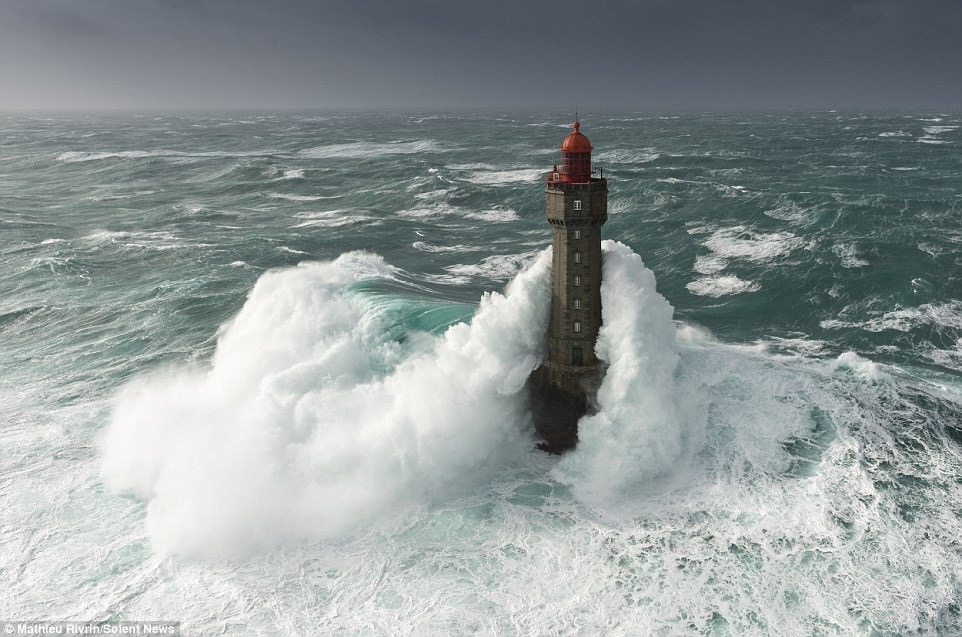
France Energies Marines is coordinating two collaborative R&D projects aimed at better understanding and predicting breaking waves in order to optimise the design of offshore wind turbines.
The fourth and final data acquisition campaign at La Jument lighthouse in Brittany, France, has just begun.
The projects use offshore structures, such as the lighthouse, as experimental devices at scale 1 and carry out measurements directly in the field.
During storms, wind turbines are subjected to high wave amplitudes, which are taken into account in the stability calculations during the design phase.
Among these waves, breakers are a particular danger because of the extreme loads they can induce on the superstructures.
In order to refine the design of offshore wind turbines and ensure their resistance to storm events, it is important to collect information on the occurrence and characteristics of breakers and the loads they generate.
It is with this objective in mind, the DIME and DIMPACT collaborative R&D projects that focus on the creation of breaking waves offshore observatories.
The DIME project, initiated in 2017, includes the experiment carried out near the Ushant island lighthouse, with the support of Cerema, Phares et Balises, Sécurité civile, Ifremer, Shom and Helmholtz-Zentrum Geesthacht.
It uses La Jument lighthouse, which is located in an area representative of the bathymetry of the areas where floating wind turbines are installed, as an experimental device on a scale of 1 and to carry out measurements directly in the field.
A current profiler located at the foot of the building and a wave buoy anchored 2km to the west provide in-situ information on waves and surrounding currents.
Accelerometers quantify the movements of the building and three pressure sensors installed on its façade determine the forces exerted by the waves.
State-of-the-art equipment has also been installed at the top of the lighthouse.
A stereoscopic camera system allows the three-dimensional shape of the waves to be reconstructed, and a radar allows the wave field to be mapped on a larger scale.
A measurement campaign has been conducted every winter since December 2017.