


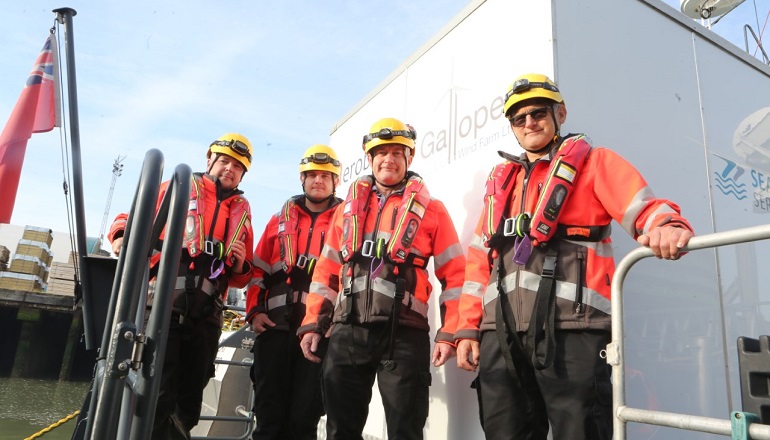
British Armed Forces personnel transitioning into civilian life have transferred their skills to working on the 353MW Galloper offshore wind farm.
Among them four members of the offshore team working at the 56-turbine facility, located 30km off the Suffolk coast, have had previous careers in the British Army, Royal Navy and Royal Air Force (RAF).
Galloper’s four ex-Forces personnel are part of a team of 60 working out of Harwich International Port, where crew transfer vessels take technicians out daily to work on the wind farm’s turbines and ensure they operate with maximum efficiency.
Both offshore supervisor Mark Annis and offshore technician Richard Holmes joined the sector from the Royal Navy where they were marine engineers working on board vessels involved with overseas operations.
Annis said: “I was a chief petty officer where team work was crucial and likewise it is also a big part of the offshore wind industry.
“The ability to work safely and to ensure that you look out for the other members in your team is vital to the success of the wind farm.”
Holmes added: “Being offshore, working in unpredictable environments and with the fact that both the renewables industry and the armed forces stand for making a better world for our children, I haven’t looked back.
“Both the offshore experience and engineering background that I had helped make the transition a smooth one.”
Former aircraft technician with the RAF, James Weller was attracted to the offshore wind industry because of its challenges, growth as a sector and the fact it meant working with new and evolving technologies.
“I worked with various squadrons including the C-130 Hercules, GR4 Tornado and Aircraft Crash Recovery and mechanically, the hydraulic and rotating systems and aerofoils on wind turbine are very similar those used on the aircraft
I was used to so transferring over was quite familiar,” said Weller.
Galloper’s production manager, Kieron Drew came to the sector after having served in the British Army commanding force protection, logistical and maintenance operations in Afghanistan and serving in Iraq, Bosnia and Northern Ireland.
Supported by Galloper’s operator, Innogy, he has continued to serve as an Army Reservist, where he has been promoted to Major.
Drew said: “The transferable technical, logistics and engineering skills from the army to offshore wind are important but just as relevant are personal skills such as leadership, physical fitness, and positive attitude.
“You need the ability to work under pressure in a hostile environment, be a team player and to maintain high standards, particularly ensuring you properly care for your personal protective equipment.
“But I also feel renewable energy is vital for our future and chose the sector because I wanted to make a difference to the world outside the army.”
As a reservist, he is able to take advantage of the assistance provided by Innogy, which has a commitment to supporting paid time off for training and ensuring a smooth transition for reservists who are mobilised into full time service.