


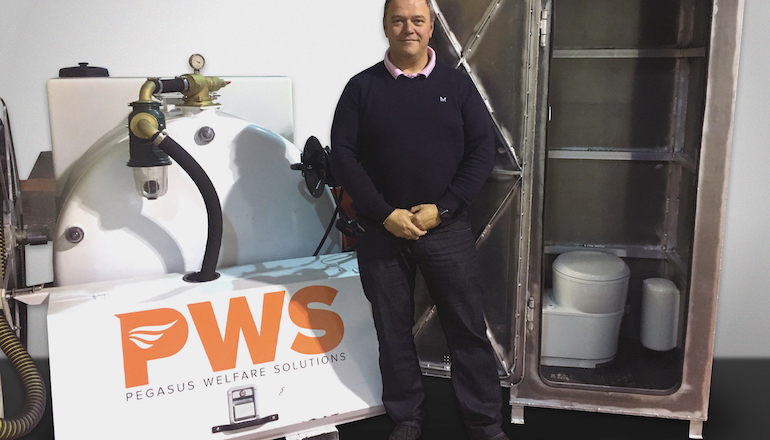
Pegasus Welfare Solutions (PWS) has unveiled the world’s first in-turbine toilet.
PWS founder Dan Greeves is a former offshore engineer and said the toilet, for which the company has secured a worldwide patent, must become industry standard.
The first retro-fit toilet unit costs just £0.5 a day for a turbine’s 20-year lifetime.
Greeves said: “Currently there is no option available for toilet facilities on either onshore or offshore wind turbines for technicians.
“For the price of a pint of milk a day, this is a solution that improves safety, productivity and will encourage more women to work in offshore wind.
“Just by having a toilet in a turbine means an average of six fewer ladder climbs and transfers to crew transfer or service operation vessels, which, while improving safety can increase productivity by an average of about 18%.”
PWS added that the innovation addresses a major offshore wind issue – how to build a larger female workforce.
Lack of offshore toilets is frequently cited as a reason why women don’t pursue offshore careers, the company said.
The UK Offshore Wind Sector Deal targets seek to double the number of women in the industry from 16% to 33% in the next 20 years.
Greeves said: “It’s a solution to a very real yet simple problem.
“Driving down costs in offshore wind has made toilets on turbines a ‘nice to have’ rather than a ‘need to have.’ Our solution has made it affordable and comes with benefits.”
ORE Catapult project engineer Lorna Bennet called the innovation an “invention that has taken remarkable engineering ingenuity”.
She said: “Minimising human presence offshore is a strategic priority for the industry, but it cannot be avoided entirely.
“This means that innovations in safety and welfare remain a priority, particularly as offshore turbines are growing in number and size, pushing ever further offshore.
“Crew transfer to and from a vessel over rolling waves can be unpleasant at any time, even more so when you need to use a toilet and each transfer increases the risks associated with working offshore.”
Greeves added: “The government wants every home to be powered by offshore wind by 2030.
“My ambition is for every turbine to have an in-tower toilet. Its benefits make it a compelling offer.
“No one has come up with the technology before. Our unit comes with its own water and power supply and take no resources from the turbine.
“Waste is secured in a sealed cassette that a technician fits at the start of the shift and removes at the end and takes it away to be cleaned.”
To retrofit, the unit arrives at the installed turbine by CTV and is lifted on to the transition piece by davit crane where it can be installed by two people.
Each unit comes with full sanitary dispenser and disposal and can be maintained in-house or by a service contract with PWS, which is based in Lenwade, Norfolk.
Offshore Wind Sector Deal people and skills director Celia Anderson said: “The industry has committed to improve the diversity of its workforce.
“Improving facilities in turbines may well contribute to addressing the gender imbalance and improving ethnic diversity of people working offshore.”