


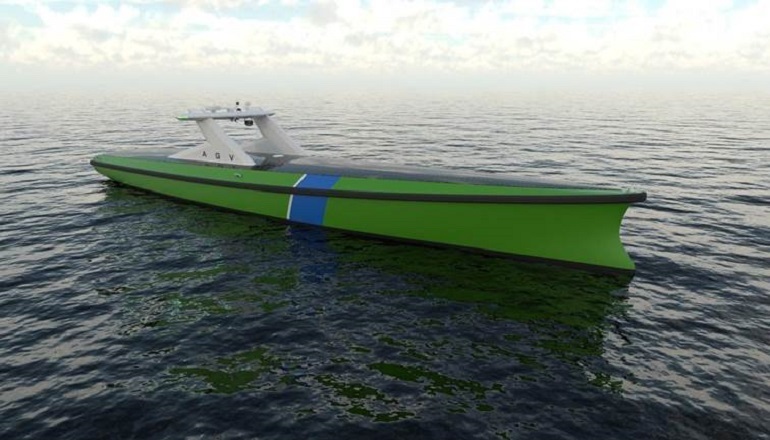
A consortium of maritime partners has unveiled a new concept design for an autonomous guard vessel (AGV) for monitoring offshore wind structures during their lifecycles.
The AGV will also ensure any vessel that intrudes the area is guided safely across the area.
Key features include unmanned vehicle technology, smaller and lighter design than most current guard vessels, more efficient operation.
The AGV is based on a sustainable design that uses battery powered propulsion, plus solar panels across the top.
It will also create minimal underwater noise to limit disturbances to local marine life.
Batteries will be recharged at a charging station that can use renewable fuels to generate power.
The concept came about in a project group facilitated by LISA, a community for maritime professionals.
The project group resulted in a consortium, which includes C-Job Naval Architects, SeaZip Offshore Service, Sea Machines, MARIN and eL-Tec elektrotechniek.
The AGV is specifically designed for surveillance of offshore structures throughout their lifecycle and can be used with turbines, substation platforms and cable routes.
The AGV can continuously monitor nearby marine traffic visually as well as via radar and AIS data and can take measures to mitigate collisions and damage to the offshore infrastructure.
An intruding vessel can be communicated with and will receive information on how to safely navigate the area as well as being physically escorted away from the site by the Autonomous Guard Vessel.
Additionally, the encounter will be recorded to provide video footage in case of any violation or accident.
LISA founding partner Pelle de Jong said: “Guard vessels perform an essential job, however, it is not the most exciting one for crew.
“Combined with the fact that conventional guard vessels are mostly outdated and thus aren’t necessarily the most comfortable let alone sustainable, it can be difficult to find well-trained crew willing to do the job.
“The group set out to improve upon the overall process of securing an offshore area while incorporating sustainable solutions and reducing overall cost. By utilising the knowledge we have as a group as well as the technology already available, we succeeded in creating a design which does this and more.”
Rolph Hijdra, autonomous research lead at C-Job Naval Architects, added: “We are pleased we were able to develop a battery-powered design, ensuring the AGV is free of harmful emissions.”