


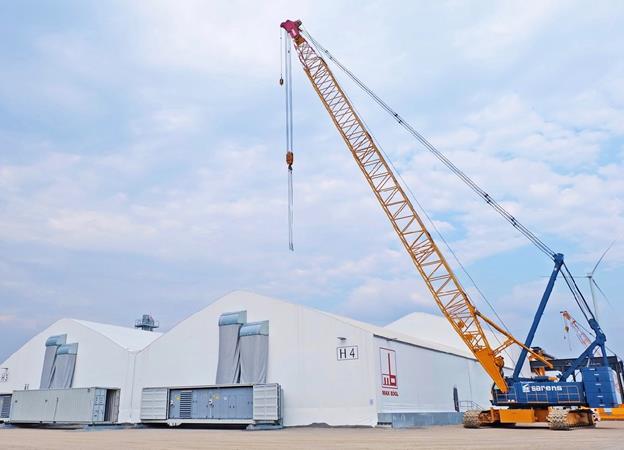
German company Max Bogl Wind has won this year’s Bauma Innovation Award for construction method for its mobile hybrid wind tower fabrication technology.
The Bauma Innovation Award has been awarded every three years since 2007 at the Bauma trade show, which covers construction, building materials, mining machines, construction vehicles and equipment.
The evaluation criteria for the construction method category includes, among other things, the degree of innovation, contribution to resource efficiency and implementation requirements.
Max Bogl said its mobile plant allows the manufacture of hybrid wind turbine towers – a combination of concrete and steel – at almost any place on the planet.
The company has erected 90 of the hybrid towers with a hub height of 156.5 metres at the Thepharak wind farm in Thailand.
It added that the work involved primarily local materials and workers.
“This increased the cost-effectiveness of the project, lowered the infrastructure burden and benefited the region as a whole,” the company said.
Max Bogl chief executive Stefan Bogl said: “From the idea to implementation and finally to this award: The entire Max Bogl team helped achieve this success with their great dedication and expertise.
“Only those who think boldly and are undaunted by challenges can realize innovative projects and make a lasting difference.”
Max Bogl Wind chief executive Josef Knitl said: “Sustainability and climate protection begins with the production of renewable energy sources.
“With our first successful project in Thailand, we have proven that we can produce hybrid towers with German manufacturing quality and in a resource-conserving manner on a global scale.
“In the future such projects will be crucial to ensuring that the green energy revolution succeeds worldwide.”
The company also produces hybrid towers at two stationary plants.
Bogl said: “The transformation from traditional construction to assembly-line construction at our company is an important building block to implementing projects even faster, more flexibly and more economically.
“For international projects we also rely on the established manufacturing processes that we use at our main plants.
“Thanks to the standardised processes, we can quickly train the local workforce in whatever region we are active and at the same time ensure high process reliability.”
He added that for the mobile fabrication concept, the company was able to adapt all equipment.
For example, it adapted the CNC concrete grinding milling system so that the concrete segments of the hybrid tower are ground milled with the same quality as in stationary systems.
“As a result, the concrete tower can be built internationally and under all weather conditions,” the company said.