


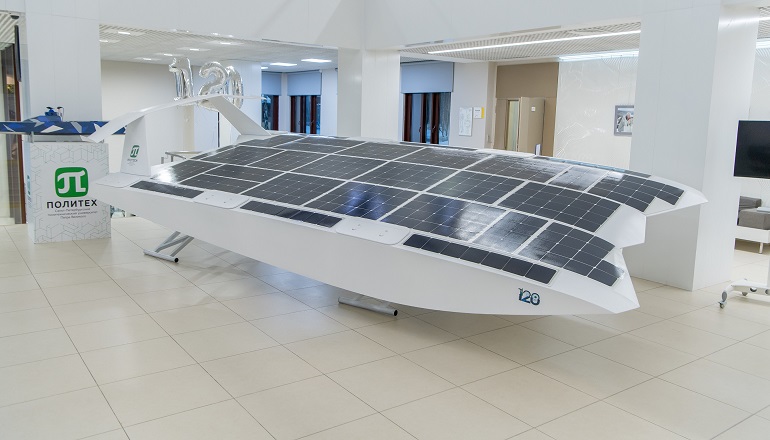
Engineers from Peter the Great St Petersburg Polytechnic University (SPbPU) in Russia are working on an unmanned solar-powered ‘flying boat’, operated using advances in artificial intelligence.
The Storm-600 wind-in-ground-effect vehicle will be capable of reaching speeds of 200km per hour with an “unlimited” power reserve.
The final prototype of the Storm-600 wing-in-ground-effect vehicle will be tested in summer 2020 on the Neva river in St Petersburg.
Photovoltaic cells connected to storage devices will be fixed to the wings and hull of the craft to power the boat along the water.
Flying boats can potentially be used for patrolling ocean areas, conducting sea-based search and rescue operations and cargo delivery.
SPbPU project head Alexei Maistro said: “The device literally floats above the water.
“There is a screen effect when an aerodynamic cushion is created under the wing of the aircraft. Our wing-in-ground-effect vehicle has long wings, thus it moves along the air cushion itself.
“In physics lessons at school there is an experiment that demonstrates a tennis ball ‘suspended’ in a stream of air from a vacuum cleaner. The tennis ball doesn’t fall down and doesn’t fly up. The same principle is used here.”
Maistro added: “We installed a laser radar (lidar) on the boat to train the wing-in-ground-effect vehicle to ‘recognise’ obstacles and avoid them.”