


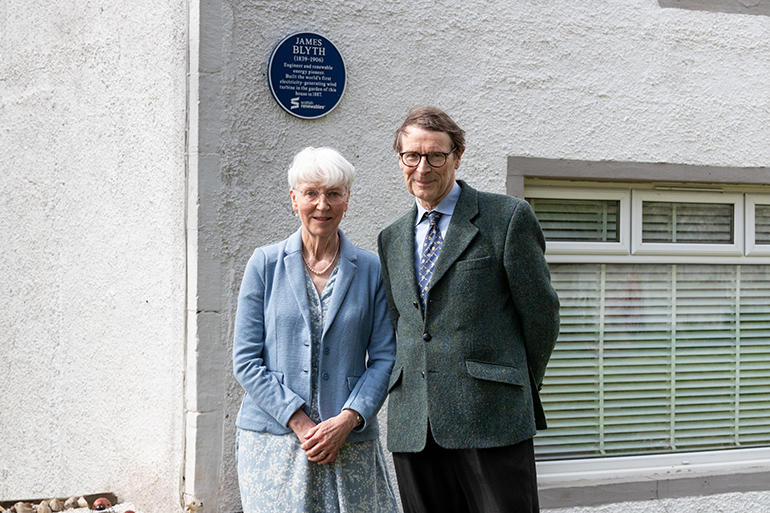
Scottish Renewables has recognised the achievements of James Blyth, ‘the father of wind power’, with the unveiling of a plaque at his former home in Marykirk, Aberdeenshire – the first building in the world to ever be powered by wind-generated electricity.
Technology has come a long way since Blyth developed the world’s first turbine capable of producing electricity from wind power in 1887.
His machines rotated with big cloth sails rather than the blades used today and modern turbines also generate a lot more energy. The most successful prototype of Blyth’s produced enough power to light ten 25-volt bulbs in a moderate breeze while the very latest turbines can produce up to 16MW, enough to power 20,000 homes.
“At Scottish Renewables, we’ve been keen to celebrate James Blyth’s life for some time and on a recent visit to Marykirk we discovered that there was nothing in the village to commemorate the father of wind power,” said Scottish Renewables chief executive Claire Mack.
“It’s phenomenal to think that this invention was born in the small village of Marykirk in 1887 and it is fascinating to hear from historians that local villagers refused Blyth’s offer to power lamps along the main street saying they thought electric light was ‘the work of the devil’.
“But Blyth, like a true pioneer, continued with his work regardless and was rewarded with a patent for his ‘wind engine’ in 1891 and received a medal from the Royal Scottish Society of Arts.
“James Blyth’s pioneering invention has grown into the global wind industry of today – one of Scotland’s proudest environmental and economic success stories. But where we are now is really only the beginning as we sit on the precipice of wind power truly transforming the world.
“By 2050, when more than 2,000GW of offshore wind will be deployed globally we will be able to draw a direct line to James Blyth from the wind technology that will be so instrumental in combatting climate change.
“We were privileged and grateful to have members of Blyth’s family, including his great granddaughter, at our event to celebrate gone of Scotland’s greatest pioneers.”
The plaque was unveiled by Blyth’s great granddaughter and Ferelith Green and great grandson George Allan (pictured).
“We were always told that our great grandfather James Blyth used to walk six miles to Montrose Academy and back again as he placed such value in his education. He was clearly a very clever man with a very curious mind,” said Green.
“He had great ambitions for the future of wind power, thinking ahead to a time when every home would have its own turbine and arguing – correctly, as we now know – that wind power was better for the environment.
“As a family we are delighted that James Blyth is being celebrated in his home village.
“When he was developing wind power in 1887 it never really took off but as it has become more and more popular as a means of generating electricity we are all really proud to see that he is now finally getting the recognition he deserves.”