


Students at the University of Rhode Island in the US have developed an acoustic device that detects sounds made by sea mammals in the vicinity of the Block Island offshore wind farm.
The students have called their device Marine Mammal Monitoring at Block Island Using Acoustics (MARIMBA).
The MARIMBA technology was created for the students’ senior capstone design class, a yearlong project that requires students to call upon all of the skills and knowledge they learned during their college careers.
The students who developed the device are Drew Adams of Bel Air, Maryland, Jake Bonney of Barrington, Rhode Island, Garrett Connelly of Wakefield, Rhode Island, Max Fullmer of Virginia Beach, Virginia, Luke Puk of Garfield, New Jersey, and Brendan Read of Middletown, Rhode Island.
University of Rhode Island ocean engineering professor James Miller advised the team.
Puk said: “What we were trying to do was detect marine mammals acoustically, using a hydrophone underwater that listens for the sounds of marine mammals, then sends those sounds to a server we have on campus, and we can listen to them live or record them.”
The biggest challenge to do this successfully was having to work from a prototype created by another team of students a year ago. This year’s group had little understanding of the software and electronics the previous group used.
The group also had to adapt the system for an ocean environment, including making it more rugged, as the original work focused on a system for a river. This work required investigating the software code the previous researchers had used.
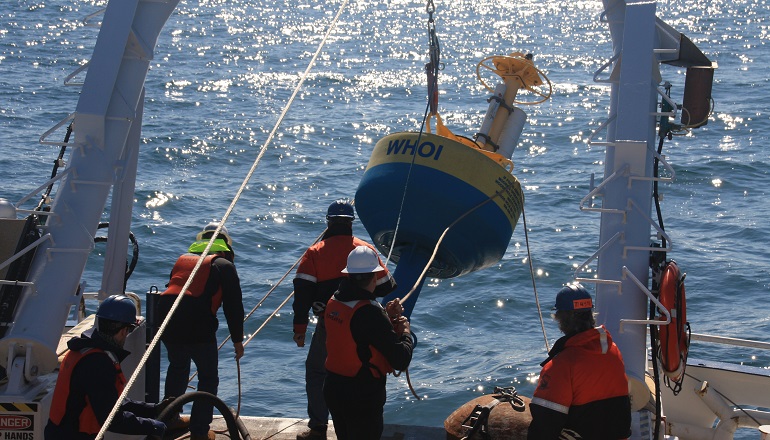
After spending the winter engineering all of the elements of the device and the communications platform, they deployed two units in Block Island Sound for two weeks in late March and early April 2019. They also collected oceanographic measurements and samples of the seafloor sediments to better understand the environment from which the device was operating.
Read said: “We heard a lot of dolphins, and some sei whales, which were confirmed by people at the Navy. We might have detected a fin whale, too, though we need to get that one confirmed.”